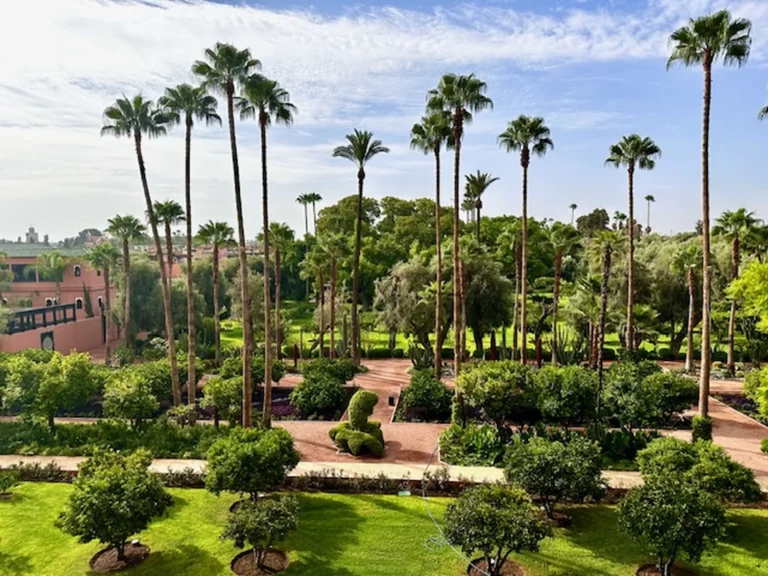
Marrakech Wedding from the UK
A Marrakech wedding from the UK takes less flying than a wedding in Scotland takes driving. Under four hours from most British airports, no visa, and in summer, no time difference at all.
What makes it feel far is not the map. It is that nobody around you has done it, so every question — what will it cost, will people come, is it even legal — has to be answered from scratch. This guide answers them, written by a team that lives in Marrakech and shoots here every season of the year.
The short answer
Direct flights run to Marrakech from Gatwick, Heathrow, Stansted, Luton, Manchester, Birmingham, Bristol, Liverpool and Edinburgh, taking roughly three and a half hours from London and four from Scotland. British citizens need no visa for stays up to 90 days. Almost every couple marries legally at a register office at home and holds a symbolic ceremony here, which removes the paperwork entirely. Book venue and photographer twelve months out, and give your guests nine.
- Flight time
- 3h30 from London
- Time difference
- 1h ahead in winter, none in summer
- Visa
- Not required, up to 90 days
- Plugs
- Type C and E — adapter needed
- Currency
- Dirham, closed currency
- Best months
- April, May, October, early November
Flights to your Marrakech wedding from the UK
Britain has more direct routes into Marrakech than almost any country outside France. At the time of writing, easyJet flies from Gatwick, Luton, Bristol, Liverpool, Manchester, Birmingham and Edinburgh. Ryanair goes from Stansted, Manchester, Birmingham, Liverpool and Edinburgh. British Airways runs Gatwick and Heathrow, and TUI and Jet2 add seasonal services from the regional airports. Royal Air Maroc connects Heathrow if your guests want a through-ticket.
London to Marrakech is around three and a half hours. Manchester and Birmingham are closer to three and three quarters, Edinburgh and Glasgow about four. Menara Airport is fifteen minutes from the medina, which is unusual — most destination-wedding cities put an hour of transfer between the runway and the hotel. Your guests land and are drinking mint tea in a courtyard before they have finished telling each other about the flight.
The catch is seasonality. Regional routes come and go, and some run only in winter or only in summer. Before you commit to a date for a Marrakech wedding from the UK, check which airports are actually flying that month, and check them for the cities your guests live in rather than the one you live in. A Manchester-heavy guest list and a date outside the Manchester season means a connection through Madrid or Casablanca for half your wedding.
One more thing worth knowing: Marrakech is a popular weekend-break city, so Thursday and Friday flights fill early and price accordingly. Guests who book six weeks out pay double what guests who book six months out pay. Say this in the save-the-date, plainly.
Passports, plugs and money
Passports and visas
British citizens do not need a visa for stays up to 90 days. Government advice is that your passport should be valid for at least three months from the date you arrive, undamaged, with a blank page for the stamp — and make sure the border officer actually stamps it, because a missing entry stamp causes real problems on the way out. Check the current position on the GOV.UK Morocco travel advice page a few weeks before you fly, and send that link to your guests instead of answering the question forty times.
Two cases that catch people out. Guests who live in the UK but hold a non-British passport often do need a visa, and the process takes weeks, so flag it in your first email rather than three weeks before the wedding. And Morocco has been rolling out an electronic travel authorisation for visa-exempt nationalities — it may or may not apply to British passports by your date, so make the GOV.UK page part of your final month checklist.
Time
Morocco sits on UTC+1 all year. In British summer time that means no difference at all, which is the single most underrated thing about a wedding in Marrakech: nobody arrives jet-lagged, and nobody’s speech happens at what their body thinks is 2am. In winter Morocco is an hour ahead. During Ramadan the clocks here shift back by an hour, so if your date falls in that window, check it rather than assume.
Plugs, water and the small stuff
Morocco uses the European two-pin socket, type C and E, at 220 volts. British three-pin plugs do not fit. Put “bring a travel adapter” on your wedding website in bold, because at least four guests will not, and one of them is doing a reading. Tap water is not for drinking. Bottled water is everywhere and costs almost nothing.
Money
The dirham is a closed currency. You cannot buy a useful amount of it from a UK bureau de change before you fly, and you are limited on taking it out again, so the Revolut-and-go habit does not fully work here. Guests should draw cash from an ATM on arrival, keep a card for hotels and restaurants, and carry small notes for taxis, the souks and tips. Tipping is normal and expected in small amounts, including from guests to the staff looking after them.
Insurance
A GHIC card is worth nothing in Morocco. Proper travel insurance is not optional for a destination wedding, and if you have paid deposits, wedding-specific cover that includes supplier failure and cancellation is worth the sixty pounds. Say it once in the guest information and leave it there.
The half-term trick
This is the piece of advice British couples find most useful and almost nobody thinks of on their own.
The two best months to get married in Marrakech are April/May and October/early November. October half-term falls in the last week of October. Late May bank holiday and the spring half-term fall in the other one. In other words, the calendar has already put a week of school holiday inside each of the two perfect weather windows for a Marrakech wedding from the UK.
Use it. A date in that week means the friends with children can come without taking the kids out of school, the working guests burn one or two days of annual leave instead of three, and the whole thing stops being an imposition. The trade-off is that flights cost more in half-term, so tell people early enough that they can book while fares are still sane.
If your guest list has no children in it, do the opposite: the week either side of half-term is cheaper to fly, quieter in the medina, and the weather is identical.
Choosing your month
Season decides more about a wedding in Marrakech than venue, budget or guest count. Spring and autumn give you warm afternoons, evenings you can eat outside in without heaters, and long soft light.
July and August are hot in a way British guests genuinely underestimate — forty degrees in the afternoon is normal, and it does not cool down until well after dark. That does not rule out summer. It turns the day into a night: ceremony at seven, dinner at ten, dancing until the light comes back, which is how Moroccan families have always done it. Venues that are booked out and expensive in May become available and affordable in August, so a summer date can buy you a property that spring cannot.
Winter is the option nobody expects. Clear skies, high teens by day, the Atlas snow-capped on the horizon, the lowest venue rates of the year and availability at places that are impossible in April. The cost is a sunset before half past five and genuinely cold nights, so everything after dark needs to be indoors or heated. For a small winter wedding in a riad with braziers in the courtyard, it is hard to beat.
Two things to check against your shortlist of dates: Ramadan, which moves about eleven days earlier each year and changes how caterers, musicians and venues operate, and the Marrakech Marathon in late January, which fills the city’s hotels.
The four kinds of venue
- Riads in the medina. Courtyard houses, most of them sleeping twelve to twenty-five. Right for a wedding of twenty to sixty where you want everyone in one place. No vehicle access, so the last few minutes are on foot and suppliers arrive by handcart.
- Palace hotels. La Mamounia, the Oberoi, the Hivernage properties. In-house events teams, generators, air conditioning, gardens older than most British hotels. Right above eighty guests, and right for anyone who wants to make decisions once and then stop.
- Private villas and the Palmeraie. Total control of the timings and the supplier list, which is what makes them the natural choice for a three-day celebration. You are also building the wedding from an empty house.
- Desert camps in the Agafay. Forty minutes out, stone hills rather than sand dunes, the Atlas behind, and the best last hour of light anywhere near the city.
British couples split fairly evenly between riads and palace hotels, with the Agafay usually appearing as the second day rather than the wedding day itself. When you are shortlisting, ask one question that venues rarely volunteer: what time does the sun leave your main space. In a medina riad the answer can be four in the afternoon, and it changes your whole timeline. You can see how each type actually looks on camera in our Morocco wedding photography and film portfolio.
Marry at the register office at home, then celebrate here with a symbolic ceremony.
What a Marrakech wedding costs
Nobody can give you a number without knowing your guest count and your venue, and anyone who does is selling a package. What is genuinely useful is knowing which lines move in your favour and which do not.
- Substantially cheaper than the UK: staff and service, flowers and greenery, styling and decoration, guest transport, musicians and traditional performers. The ratio of staff to guests at a normal Marrakech wedding would be a luxury upgrade at home.
- The same or more: the palace hotels, which price themselves against London and Paris rather than against Morocco. Imported wine and spirits, which carry heavy duty. And any supplier you fly in, whose flights, hotel and travel days sit on top of the fee.
- Where the maths goes wrong: villa weddings. An empty private house looks like a bargain until catering, furniture, glassware, sound, lighting, a generator and thirty staff have all been brought in. Riads and hotels absorb most of that invisibly, which is why they often work out cheaper than the villa that quoted less.
Two questions to ask every supplier before you sign. Do you quote in euros or dirhams, and who carries the exchange-rate movement between deposit and final payment? With sterling, that answer has been worth real money to couples in both directions.
The honest comparison: most British couples find a Marrakech wedding lands below what the same standard of wedding would cost at home, with the difference being that part of the budget has moved from you to your guests in the form of flights and hotels. That trade is the whole conversation, and it is better had out loud, early.
The legal side
Marry legally at home and celebrate here. That is what almost every British couple does, and it is what we would tell a friend.
In England and Wales that means giving notice at your local register office, waiting the statutory 28 days, and having a short statutory ceremony with two witnesses. Scotland and Northern Ireland run their own processes, so check with your own registrar rather than a friend’s. Many couples do it quietly a few weeks before flying and tell nobody, which keeps the Marrakech ceremony feeling like the real one, because emotionally it is.
A legally binding marriage performed in Morocco is a different proposition. Civil marriage here is generally available only where one partner is Moroccan, and the route for two foreign nationals is heavy with documents, translations, legalisation and court steps, followed by getting the Moroccan certificate recognised at home. It adds months and changes nothing about the day. If you are set on it, start with the British Embassy in Rabat and the GOV.UK guidance on marrying abroad at least six months ahead, and follow them rather than any blog, this one included.
A symbolic ceremony, by contrast, has no rules at all. Any location, any officiant, any language, any hour. Sunset in the Agafay is a legitimate ceremony time here in a way it never is in a licensed venue at home.
Building a weekend, not a day
British weddings are built around one long day, and the destination version does not work that way. Your guests have flown for four hours and taken time off. Giving them a single evening is a waste of what they have spent.
The shape that works is three days. A relaxed welcome dinner on the Thursday or Friday, on a rooftop or in the riad courtyard, which does the job that a receiving line does badly — everyone meets everyone while nobody is nervous. The wedding day itself on the Saturday. Then a long lunch on the Sunday before people scatter to their flights.
Some couples add a fourth element: a morning in the Agafay or an afternoon at a hammam, usually for the smaller group who came for the whole week. If you are already this far from home, the coast is only two and a half hours away, and a night in Essaouira after the wedding turns the trip into a proper holiday for the people who travelled furthest.
Also, drop the British evening-guest convention. It does not exist here. Everyone who gets on a plane is a full guest.

Your guests
Nine to twelve months’ notice, minimum
Send the save-the-date far earlier than you would at home. People need to book flights while they are cheap, request leave, and in some cases arrange several days of childcare rather than one evening of babysitting.
Some will say no, and that is fine
A destination wedding is a real ask of money and time, and a proportion of your list will not come. Couples who accept that in month one enjoy the year far more than couples who spend it negotiating with an aunt.
One page beats twenty messages
A simple wedding website — airport, three hotels at three price levels, dress code, what the weather actually does that month, and what happens on each of the three days — answers almost everything people would otherwise ask you individually.
Book more than one riad
Riads are small. One that sleeps twenty is full at twenty. If most of your guests want to stay in the medina you will need two or three houses, and they should be a short walk from each other, because addresses in the medina are not something a taxi can find.
Be honest about the heat and the dress code
If your date falls between June and September, describe the afternoon plainly and say what you have planned around it. British guests take a dress code seriously and will wear a three-piece suit in thirty-eight degrees rather than risk being underdressed. Tell them linen. Tell them no morning suits. They will thank you.
Bringing a photographer, or not
For a Marrakech wedding from the UK this is usually the first supplier question, and it deserves a straight answer rather than a sales pitch.
Bringing someone from home has one genuine advantage: you have met them, you have seen their work in person, and you share every reference point. The costs are less visible in the quote. Return flights, two or three nights of accommodation, travel days that are either billed or quietly absorbed, kit as excess baggage, and the fact that they will see your venue for the first time on the morning of the wedding.
A team based here knows that the courtyard at your riad loses its light at six, that the wind gets up in the Agafay after four, which route through the medina avoids the Saturday crush, and who to call when a generator dies an hour before dinner. On a normal wedding that knowledge is a nice-to-have. On a wedding where you have no fallback and no local number to ring, it is the difference between a plan and an improvisation.
The split most couples land on: a local photography and film team, a local planner, and one or two people from home for the parts that are personal — usually a celebrant, sometimes a hair and make-up artist who already knows the bride’s face. Our photography, film and drone services in Morocco are built around exactly that arrangement.
Timeline
- Twelve months out. Pick the date around season, half-term and flight routes. See venues in person or by video call. Book the venue, the photographer and the videographer. Good ones are gone a year ahead for spring and autumn Saturdays.
- Nine months out. Save-the-date with the airport, the dates and a rough flight price. Block your riads or hotel rooms. Appoint a planner if you are using one.
- Six months out. Give notice at the register office. Confirm catering and drinks. Agree the styling. Book the celebrant.
- Three months out. Close the guest list. Arrange transport between hotels and venue. Build the running order backwards from sunset on your actual date, not a typical one.
- One month out. Final numbers, a written schedule circulated to every supplier, a wet-weather plan for spring, and a last check of the GOV.UK entry page.
- The week itself. Arrive two days early at least. There is no jet lag to recover from; the reason to come early is that a hundred small decisions land in the last forty-eight hours and you want to be making them in a courtyard, not an airport.
Planning from Germany instead?
Flight routes, the Standesamt question and the German school-holiday calendar all work differently. We have written a separate guide for that: planning a Marrakech wedding from Germany.
Questions couples ask about a wedding in Marrakech
Do we need a visa for a Marrakech wedding from the UK?
No. British citizens travel to Morocco visa-free for up to 90 days. Guests on other passports, including UK residents without a British passport, often do need one, and the process takes weeks — ask early rather than late.
Is Marrakech safe for our guests?
It is a major tourist city with millions of visitors a year, and the sensible-city rules apply: keep an eye on belongings in the souks, use official taxis or hotel transfers, and agree the fare before getting in.
Do we need a wedding planner?
For a riad or a private villa, almost certainly, because someone has to coordinate suppliers on the ground while you are in Britain. For a palace hotel with its own events team, often not.
Can we serve alcohol at our wedding?
Yes, at licensed hotels, riads and villas. It is not sold in the medina, imported bottles carry heavy duty, and service is restricted on certain religious dates. Raise it in the first conversation with your venue, not the last.
How much does a Marrakech wedding cost compared with a wedding in the UK?
Service, flowers, styling and transport cost considerably less. Palace hotels and imported alcohol do not. Most couples land below the cost of an equivalent UK wedding, with part of the budget shifted from the couple to the guests as flights and hotels.
What is the weather like in October?
Warm days in the high twenties, comfortable evenings, and sunset around half past six. It is one of the two best months of the year here, and it overlaps with October half-term.
What language will the day be in?
Whatever you want. Suppliers here work in English and French as a matter of course. If you want the ceremony in English, say so when you book the celebrant and it is simply done.
How many days should we plan?
Three is the norm: welcome dinner, wedding day, long lunch. Many couples add a day at the front because guests arrive from different airports at different hours.
Should we visit before booking?
If the budget allows, yes. A long weekend seeing three venues costs less than choosing the wrong one from photographs. Plenty of couples combine it with their engagement shoot.
How far ahead should we book photography and film?
Twelve months for spring and autumn Saturdays. Those go first, and half-term weekends go first of all.
We live and work in Marrakech. We know which riad courtyard is dark by six and which garden faces the sunset.
If you are planning a Marrakech wedding from the UK, send us your date and the venues you are considering, and we will tell you honestly whether they work together. More planning notes are in our Morocco wedding guide.
Check your date