Indian Wedding in Morocco
Everything that goes into an Indian wedding in Morocco — the venues, the five-day timeline, the real costs, and the traditions Indian and Moroccan families have quietly shared for centuries.
An Indian wedding in Morocco has become one of the most requested celebrations in destination weddings — and the reason has less to do with scenery than most people assume.
Yes, the light is extraordinary. Yes, a riad courtyard makes a mandap look like it was always meant to be there, and the Agafay Desert gives you a sangeet under a sky with no light pollution for forty kilometres. But couples keep choosing Morocco for a simpler reason: the country already knows how to host a wedding like yours.
Moroccan weddings run for several days. They are loud, they involve the entire extended family, they revolve around henna, drums, gold, feasting and a bride who changes outfits more times than anyone can count. Vendors here don’t need the concept explained to them. When you tell a Marrakech venue that three hundred guests are arriving for five days and there will be a horse involved, nobody blinks.
We’re a wedding photography and videography team based in Marrakech, and we’ve spent years shooting inside both traditions. This guide covers where to hold an Indian wedding in Morocco, how the days actually fall, what the logistics really cost you in effort, and the surprising amount of common ground between two cultures separated by seven thousand kilometres.
Why couples choose an Indian wedding in Morocco
The flights are short. Four to five hours from London, three from Paris, seven from Dubai. For a diaspora wedding pulling guests from the UK, Europe, the Gulf and India, Marrakech sits in the middle of everyone. Direct routes into Marrakech Menara (RAK) and Casablanca (CMN) run year-round.
Visas are simple. Indian passport holders can enter Morocco visa-free for stays up to 90 days, and most European, UK, US and Gulf residents need nothing either. For a wedding with two hundred international guests, that removes the single biggest source of chaos.
The venues are built for volume. Palace hotels, private estates, desert camps and riads here are used to full buy-outs. La Mamounia, the Oberoi, Fairmont Royal Palm, Selman, the Agafay camps — these are properties that regularly close their doors for one family.
Your budget goes further. A five-day wedding in Morocco typically lands well below the equivalent in Italy, the South of France or Dubai, for the same tier of property and service. Indian catering, décor volume and staffing are where the savings show most.
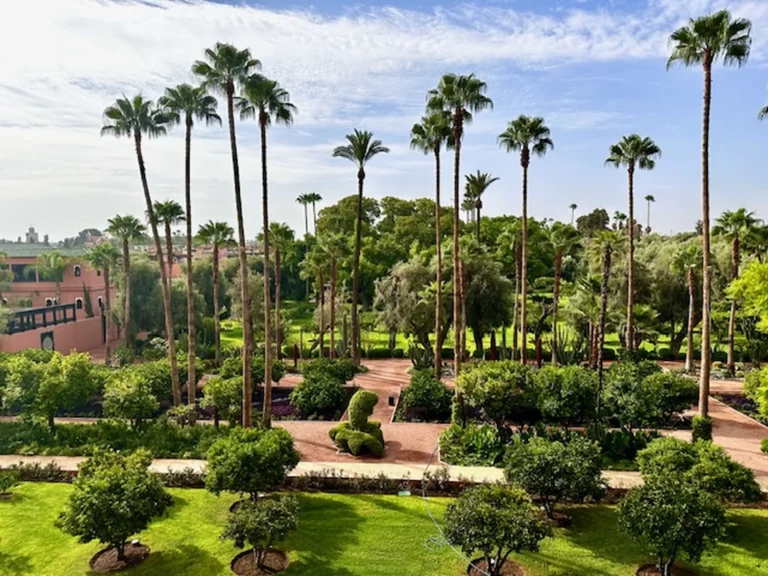
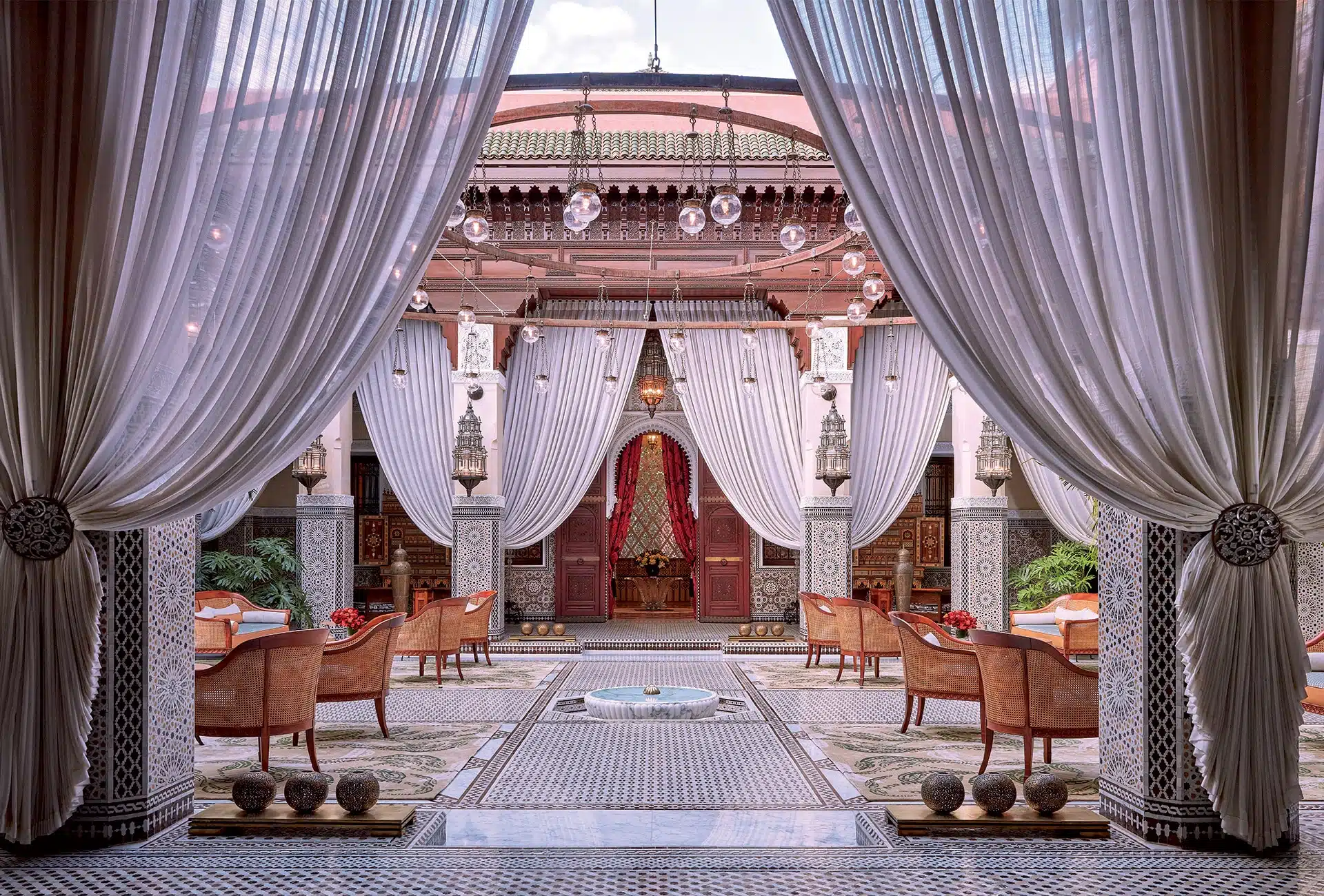
And the aesthetic already matches. Carved plaster, brass lanterns, deep colour, geometric tilework, courtyards designed around a fountain — Moroccan architecture and North Indian palace architecture come from overlapping traditions. A haldi in a Marrakech courtyard doesn’t look transplanted. It looks like it belongs.
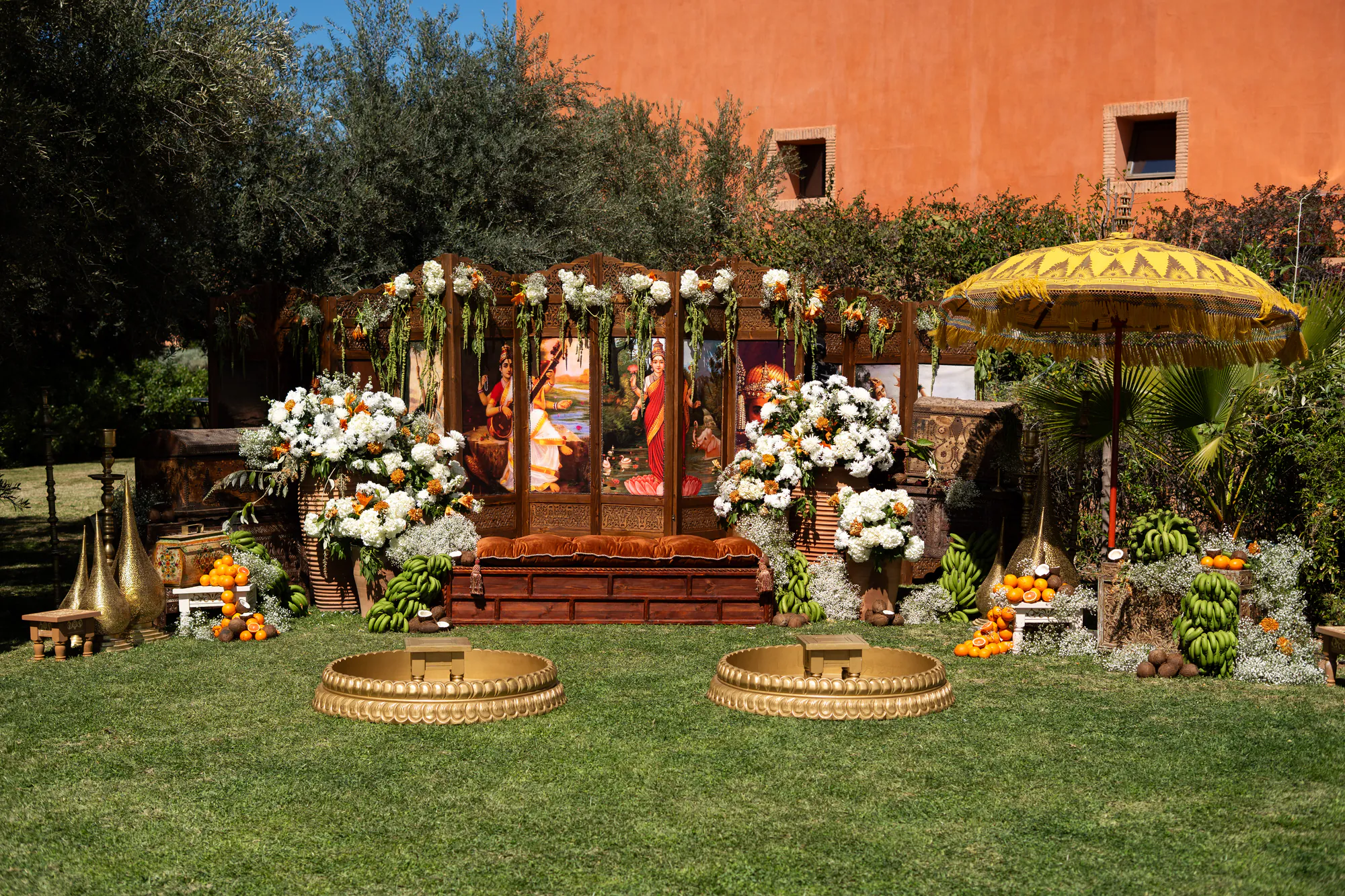
Left: mehndi, the night before. Right: a baraat arriving through a riad gate.
Where to hold an Indian wedding in Morocco
Four landscapes for an Indian wedding in Morocco, all within about an hour of Marrakech. Most couples use two or three of them across the week rather than staying in one place.
Marrakech riads and palace hotels
The default and the strongest option. Courtyard ceremonies, rooftop sangeets, ballroom receptions. Full buy-outs of a large riad give you a private compound for the family; palace properties like La Mamounia, the Royal Mansour and the Oberoi handle three-hundred-guest receptions without strain. Best for: the pheras, the reception, guests who want comfort.
The Agafay Desert
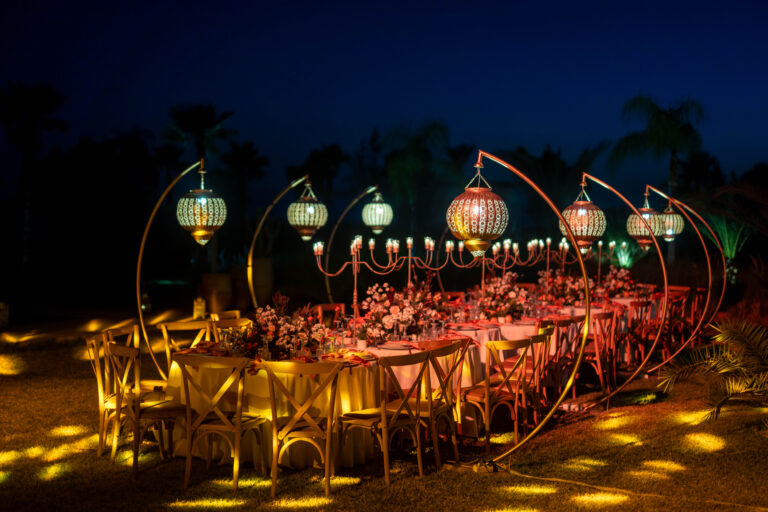
Thirty minutes from the city — a stone desert with the Atlas Mountains on the horizon. Luxury tented camps here are made for exactly this: a sangeet or a mehndi under open sky, fire pits, long tables, dancing until three. The light in the last hour before sunset is the best in Morocco. Best for: sangeet, mehndi, welcome dinner.
The Atlas Mountains
An hour out, into the Ourika and Asni valleys. Cooler air in summer, terraced gardens, snow on the peaks from December to April. Quieter and greener than the desert, and a genuine relief if you’re marrying in June. Best for: haldi, intimate ceremonies, morning pujas.
Essaouira and the Atlantic coast
Two and a half hours west. Wind, wide beaches, white-and-blue ramparts, horses at sunset. Not the easiest logistics for a full multi-day wedding, but unmatched for a beach reception or a couples’ shoot the day after. Best for: post-wedding portraits, a final-day brunch.
An Indian wedding in Morocco: how the five days fall
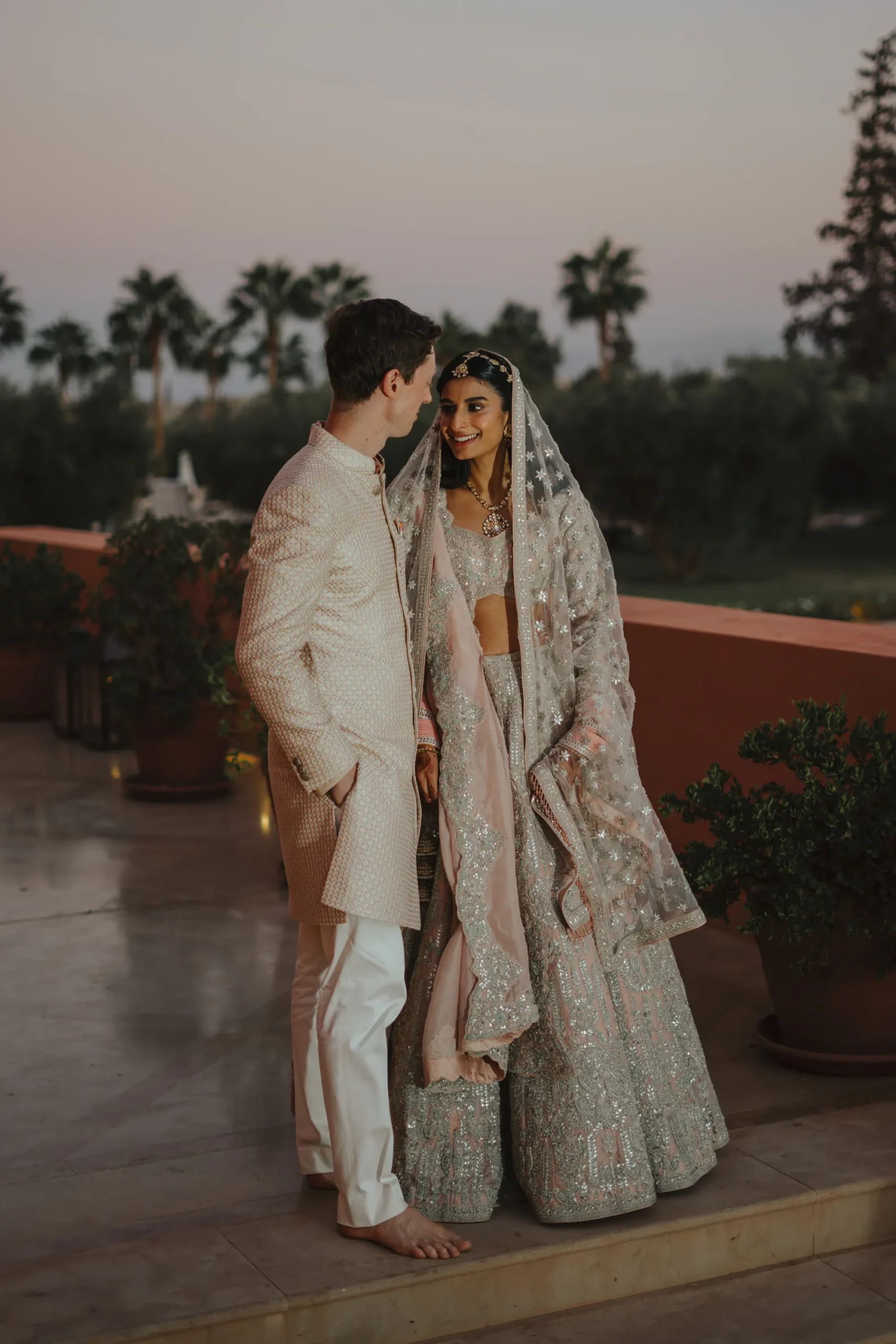
A five-day structure for an Indian wedding in Morocco that works with local venues, Moroccan heat and international guests. Adjust freely — this is the shape we see most often.
-
Day one
Arrivals and welcome dinner
Guests land through the afternoon. A relaxed dinner in a riad courtyard with mint tea, dates and milk on arrival — the Moroccan welcome, which lands beautifully with Indian families who do the same thing with a tilak and sweets.
-
Day two
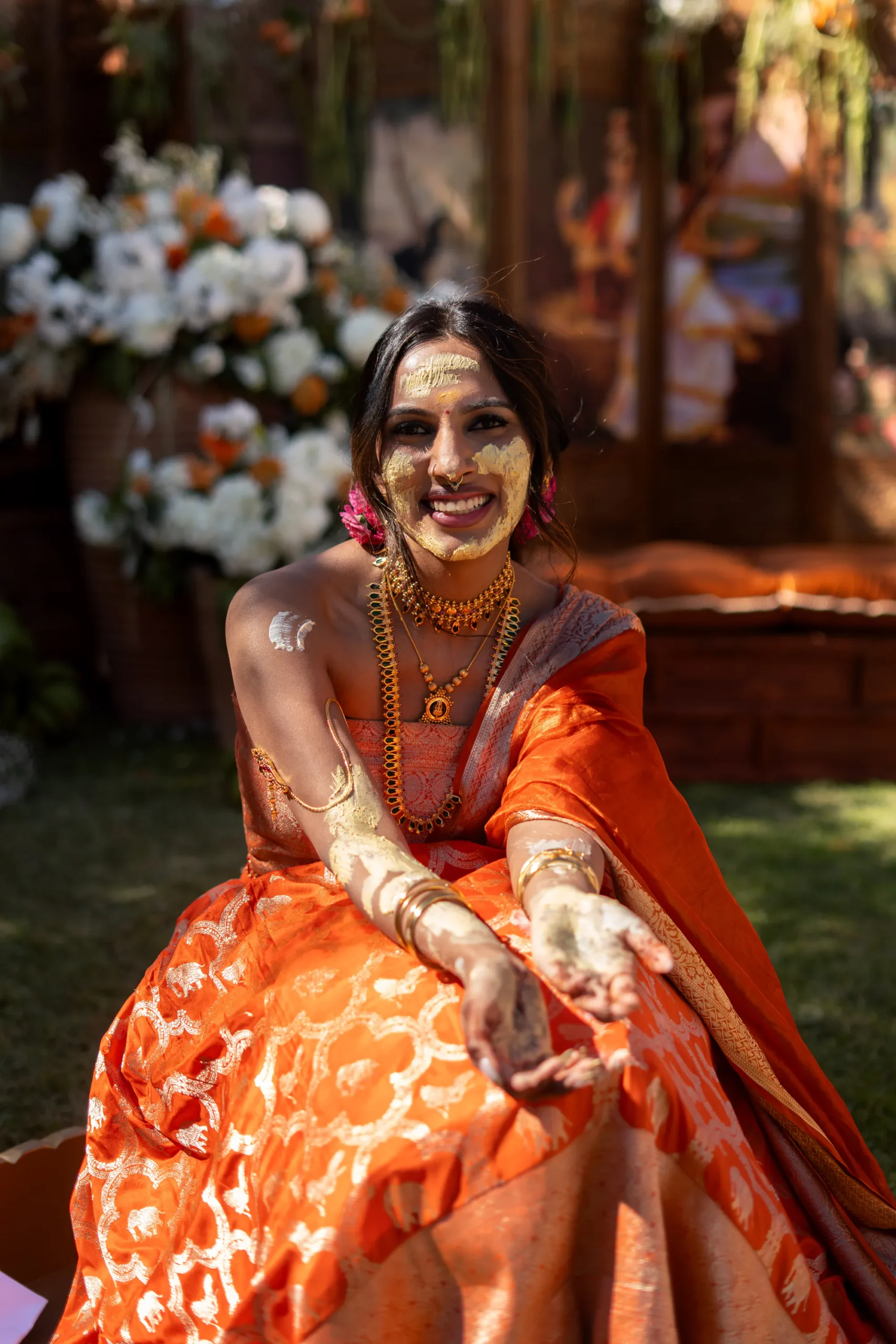
Ganesh puja and mehndi
Puja in the morning, small and family-only. Mehndi in the late afternoon once the heat breaks. Book Moroccan henna artists alongside your Indian ones — the styles are different and guests love having both offered.
-
Day three
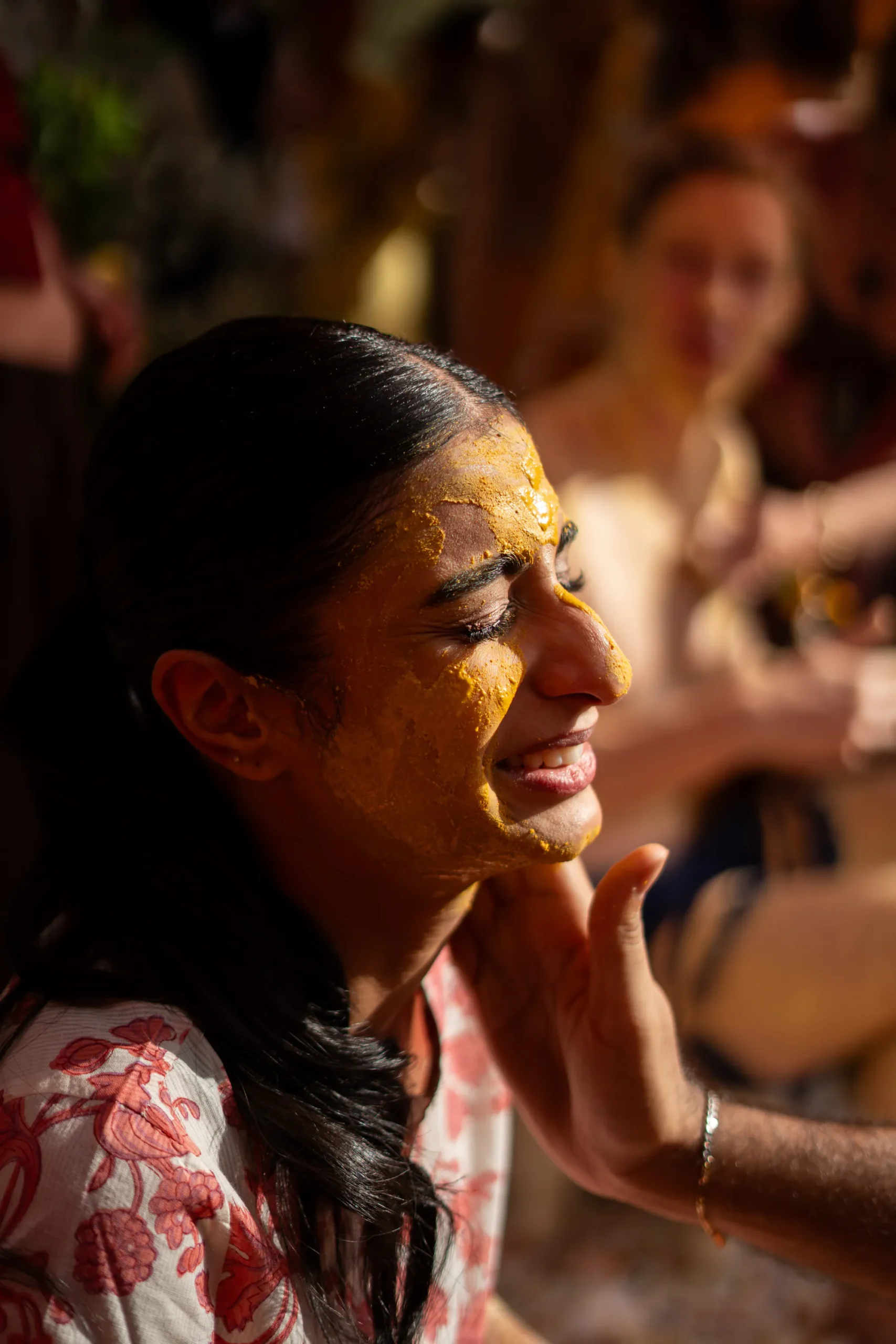
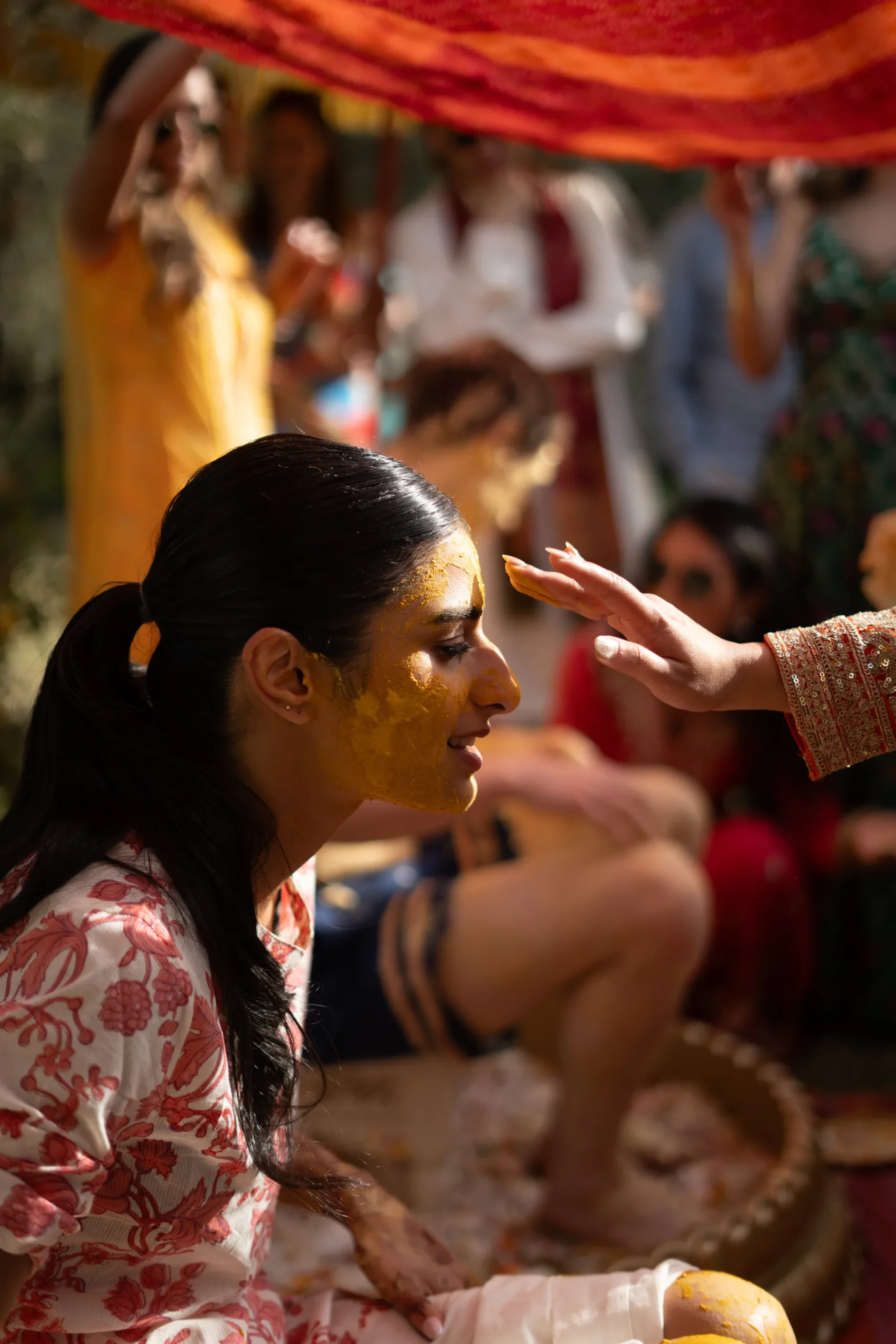
Haldi, then sangeet in the desert
Haldi in the morning in a garden or courtyard. Convoy out to Agafay at four, sundown drinks, dinner, performances, dancing. The single most photographable night of the week.
-
Day four
Baraat, ceremony, reception
Baraat with dhol players — and if you want it, Moroccan dqqa drummers joining in, which is the moment everyone films. Pheras under the mandap. Reception into the night. Start the ceremony late enough that you’re not exchanging vows at 40°C.
-
Day five
Brunch and portraits
A slow farewell brunch, then the couple’s shoot — the medina, the desert, the coast, or all three. This is when we get the images that end up largest on your wall.
What India and Morocco already share
This is the part that surprises families when they arrive. Indian and Moroccan wedding traditions developed independently, on opposite ends of the Islamic and Indian Ocean trade world — but they arrive at the same rituals again and again. Here they are, side by side.
Mehndi
The bride’s hands and feet covered in fine floral and paisley henna the night before, surrounded by women, food and music. The groom’s initial hidden in the pattern for him to find.
Laylat al-Henna
The same night, the same purpose. Moroccan henna leans geometric — Fassi motifs, sometimes outlined in black harkous. Both cultures say the darker the stain, the more she is loved.
Baraat
The groom arrives in procession, traditionally on a white mare, ahead of a crowd of dancing family members and drummers. Movement, noise, and the whole street watching.
Amariya
The Moroccan bride is carried into her wedding on a decorated palanquin, lifted by four men, above the heads of the guests. Same instinct: the entrance is a spectacle, not a walk.
Dhol
A double-headed drum leading the procession. The rhythm tells the crowd when to move and when to dance. No dhol, no baraat.
Dqqa and Gnawa
Marrakech’s dqqa marrakchia is a drum-and-voice procession troupe; Gnawa groups bring krakebs and guembri. Both are hired for exactly the same job — to make an entrance impossible to ignore.
The outfit changes
A different lehenga or saree for every function — mehndi, sangeet, ceremony, reception — each with its own jewellery set, often chosen by the mother and aunts.
The neggafa
A Moroccan bride changes takchita five to seven times in one night, dressed and re-dressed by a neggafa — a professional bridal dresser who runs the whole evening. Indian families recognise her instantly.
Streedhan gold
Gold given to the bride by both families — bangles, chains, a mangalsutra. It is hers alone, and it is worn, not stored.
Moroccan bridal gold
Heavy belts, chokers and the jewelled Fassi headpiece, largely inherited down the female line. Same principle: gold on a bride is security, not decoration.
Mithai and chai
No one leaves without sweets. Boxes of barfi and ladoo pressed into guests’ hands on the way out, chai poured continuously for anyone who sits down.
Chebakia and mint tea
Honeyed chebakia, kaab el ghazal, briouat — stacked in pyramids, offered constantly with mint tea poured from height. Refusing the third glass is, in both cultures, mildly offensive.
Multi-day by default
Three to five days minimum, each with its own function, its own dress code, its own set of relatives running it.
Multi-day by default
Traditional Moroccan weddings ran up to seven days, and rural celebrations still do. Neither culture has ever understood the idea of a wedding that takes an afternoon.
There’s a practical consequence to all of this, and it’s the real argument for Morocco. Your Moroccan vendors are not adapting to an unfamiliar culture — they are doing a version of what they already do. The florist understands scale. The caterer understands that dinner starts at eleven. The venue understands that the music does not stop at midnight.
Two traditions that never had to be introduced.
The logistics, honestly
Catering
Catering is the one thing to settle first at any Indian wedding in Morocco. Several Marrakech venues now have in-house Indian kitchens, and the rest will host a flown-in team from London, Dubai or Mumbai. Say the words “pure vegetarian”, “Jain”, “no onion no garlic” or “halal” at the enquiry stage, not later — a separate kitchen line has to be planned, not improvised. Moroccan produce is superb, and a Moroccan-Indian fusion night usually becomes a guest favourite.
Alcohol
Freely available at licensed hotels and private estates. Costs are high because of import duty, so factor it in early, and confirm your venue’s licence in writing if the reception runs late.
Décor and florals
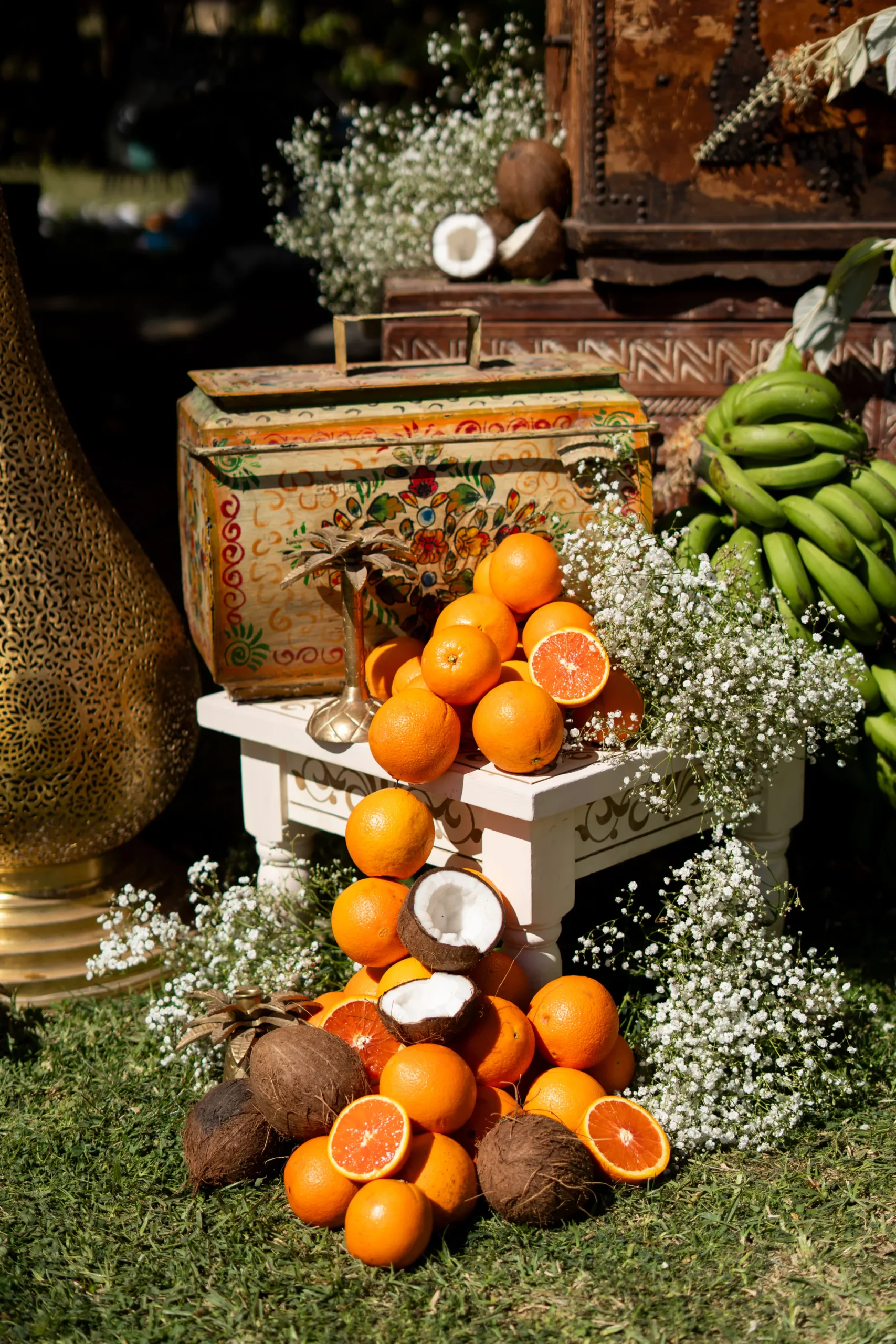
Marigolds are imported and priced accordingly. Local roses from the Dades Valley, bougainvillea, palm and citrus are abundant and cheap, and they photograph beautifully against white and zellige. The best-looking Indian weddings here lean into Moroccan materials — brass, lanterns, carved wood, raw silk — rather than shipping a Delhi mandap by air freight.
Season
March to May and September to November are the ideal windows for an Indian wedding in Morocco. June to August in Marrakech regularly passes 40°C — workable if you move everything to evenings and use the mountains for daytime functions. December and January are cool, clear and quiet, with snow on the Atlas in your background.
Legal
Civil marriage in Morocco for two non-residents is slow and paperwork-heavy. Almost every couple marries legally at home first and holds the full religious and cultural ceremony here. It changes nothing about the day.
Drone
Drone use in Morocco is regulated by the national aviation authority and needs prior authorisation — this is not something to sort out on the day. We’re licensed and insured, and we file the permissions as part of the booking, which is worth knowing before you hire an unlicensed operator and lose the aerials entirely.
Filming an Indian wedding in Morocco
A five-day Indian wedding in Morocco is not a longer version of a one-day wedding. It’s a different job. Functions overlap, the light changes completely between a courtyard haldi and a desert sangeet, and there are moments — a father’s face during the vidaai, a grandmother watching the baraat — that happen once and are never repeated.
We work as one team for photo, film and drone. That matters more here than anywhere: your gallery and your film come back graded to match, from the same crew who knew where to stand for the pheras because they’d already scouted the courtyard. No two companies negotiating for the same corner. No clashing styles across five days of footage.
We also know the country. Which riad courtyard holds light until seven. How long the convoy to Agafay really takes with two hundred guests. Which medina alleys we can shoot in without a crowd. That knowledge is the difference between images you like and images you keep.
See the full portfolio, read about our services, or browse the rest of our Morocco wedding guide.
Questions we get asked
How much does an Indian wedding in Morocco cost?
Most couples planning an Indian wedding in Morocco land between €80,000 and €400,000 depending on guest count, venue tier and how much is flown in. A three-day wedding for 100 guests at a mid-range riad sits at the lower end; a five-day palace buy-out for 300 with imported catering and décor sits at the upper. Morocco generally comes in below comparable weddings in Italy, France or Dubai for the same standard of property.
Do Indian citizens need a visa for Morocco?
No. Indian passport holders can enter Morocco visa-free for stays of up to 90 days. Guests travelling on UK, EU, US, Canadian and most Gulf passports also enter without a visa. Always confirm current rules with the Moroccan consulate before booking, as policies can change.
Can I have a Hindu ceremony with a mandap, fire and a pandit in Morocco?
Yes. Venues here regularly host full Hindu ceremonies with a mandap and sacred fire — the agni is normally permitted outdoors in a courtyard or garden with the venue’s fire-safety sign-off. Most couples bring their own pandit; some planners can arrange one. Confirm the fire arrangement in writing when you book.
What is the best time of year for an Indian wedding in Marrakech?
March to May and September to November. Days are warm, evenings are comfortable, and the light is at its best. June to August is very hot inland and works only with evening functions or a mountain venue. December to February is cool and clear, with snow on the Atlas Mountains behind you.
Can Moroccan venues cater pure vegetarian or Jain food?
Yes, but it has to be arranged in advance. Several Marrakech properties have dedicated Indian kitchens, and the rest will accommodate a specialist catering team brought in from London, Dubai or India. Raise pure vegetarian, Jain or no-onion-no-garlic requirements at your first enquiry so a separate kitchen line can be planned.
Do you travel outside Marrakech for weddings?
Yes. We’re based in Marrakech and cover the Agafay Desert, the Atlas Mountains, Essaouira, Casablanca, Rabat, Fez and Tangier, and we travel internationally. Multi-location weddings across several Moroccan cities are something we shoot regularly.
Planning yours?
Tell us the dates, the venue and how many days you’re planning for your Indian wedding in Morocco. We’ll come back with availability and what a full-week package looks like.
Check our availability