Marrakech Wedding from Germany
A Marrakech wedding from Germany is closer than most couples assume: under four hours in the air, no meaningful time difference, no visa, and the same plug sockets you have at home.
The distance that actually needs planning is not geographic. It is the distance between what your guests imagine and what the trip really involves. This guide covers everything a German couple needs to decide before booking a wedding in Marrakech, written by people who live and work here rather than fly in twice a year.
The short answer
Direct flights connect Marrakech with Berlin, Cologne, Frankfurt, Munich, Hanover, Hamburg, Stuttgart and the low-cost airports at Weeze and Hahn, in roughly three and a half to four hours. German, Austrian and Swiss citizens travel visa-free for up to 90 days. Most couples marry legally at their Standesamt at home and hold a symbolic ceremony here, which removes almost all bureaucracy from a Marrakech wedding. Give your guests nine to twelve months’ notice.
- Flight time
- 3h30 – 4h direct
- Time difference
- None in winter, −1h in summer
- Visa
- Not required, up to 90 days
- Currency
- Dirham, closed currency
- Power
- 220V, type C and E
- Best months
- April, May, October, early November
Getting to your Marrakech wedding from Germany
Marrakech Menara Airport sits about fifteen minutes from the medina, which is unusually close for a destination wedding city. Your guests land and reach their riad before they have finished complaining about the flight. Compared with Puglia, Mallorca or Santorini, arrival day is the easiest part of a Marrakech wedding.
Ryanair flies direct from Berlin, Cologne, Frankfurt-Hahn and Weeze. Discover Airlines connects Frankfurt and Munich. Eurowings operates from Hanover and Stuttgart, easyJet from Hamburg, and Transavia from Weeze. Flight time is around three and a half to four hours depending on the airport, and fares outside the school holidays are frequently under a hundred euros return.
One important caveat: several of these routes are seasonal, and airlines add and drop them regularly. Some Hanover and Stuttgart services run only in winter. Before you fix a date for your Marrakech wedding from Germany, check which routes actually operate in that month, and check from the airports your guests will realistically use rather than only your own. A date that falls outside the direct-flight season can add a connection in Madrid or Casablanca to every single guest’s journey, which turns a half-day trip into a full one.
Guests travelling from Austria and Switzerland have direct options too, from Vienna, Zurich and Geneva. If your guest list is spread across the German-speaking countries, build your date around the two or three airports that serve the largest groups.
Time, passports and money
Time
Morocco stays on UTC+1 all year. In German winter that means no time difference at all. In German summer, Marrakech is one hour behind. One exception is worth knowing: during Ramadan, Morocco moves its clocks back by an hour, so the gap changes for that period. For a wedding in Marrakech this matters mainly for coordinating suppliers by phone while you are still in Germany.
Passports and visas
German, Austrian and Swiss citizens do not need a visa for stays up to 90 days. Passports must be valid — confirm the current requirement with the Auswärtiges Amt close to your travel date, since these rules occasionally change. Send that link to your guests rather than answering the question thirty times yourself.
Money
The Moroccan dirham is a closed currency. You cannot get any meaningful amount of it from your bank in Germany before you fly, and there are limits on taking it out again. Guests should exchange on arrival, bring a card for hotels and restaurants, and carry cash for the medina, taxis and tips. Tipping is customary and expected in small amounts almost everywhere, including from wedding guests to the staff who look after them.
Details that stop questions before they start
Plug sockets are the same as Germany — 220 volts, type C and E, no adapter needed. Tap water is not for drinking; bottled water is everywhere and cheap. Alcohol is served in licensed hotels, riads and restaurants and sold in larger supermarkets, but not generally in the medina, and it is restricted on certain religious dates. If your celebration includes a bar, confirm this with your venue at the first conversation rather than the last.
Choosing your month for a wedding in Marrakech
The season shapes a Marrakech wedding more than any other decision. April, May, October and early November are the strongest months: warm days, evenings comfortable enough to eat outdoors without heating, and long usable light. March and late September cost less and are close behind.
July and August are genuinely hot, regularly passing forty degrees in the afternoon. That does not rule out a summer wedding in Marrakech, it simply makes it a night wedding — ceremony at seven, dinner at ten, dancing until sunrise, which is how Moroccan families have always celebrated. Luxury venues also drop their rates in high summer, so a property that is out of reach in April becomes possible in August.
Winter is the quiet secret. Days in the high teens under a clear sky, the Atlas Mountains visible and snow-covered behind the city, the lowest prices of the year and wide availability at venues that are impossible in spring. The trade-off is cold nights and a sunset before half past five, so you need heated or indoor space after dark.
Two dates deserve a calendar check before you commit: Ramadan, which moves earlier by about eleven days each year and changes how venues, caterers and musicians operate, and the German school holidays, which decide both what flights cost your guests and whether the families among them can travel at all.
Where a Marrakech wedding happens
There are four kinds of venue, and they suit very different weddings.
- Riads in the medina. Traditional houses built around a courtyard, right for twenty to sixty guests who want intimacy over grandeur. No car access, so guests walk the last few minutes and suppliers arrive by handcart.
- Palace hotels. La Mamounia, the Oberoi, the Hivernage properties. Full event teams, generators, air conditioning and century-old gardens. Right for eighty guests and up, and for families who want nothing to organise.
- Private villas and the Palmeraie. Complete control over timing and suppliers, ideal for a three-day celebration, but you are building the wedding from nothing.
- Desert camps in the Agafay. Forty minutes from the medina, pale stone hills with the Atlas on the horizon, and the best hour of light in the region.
German couples most often choose a riad for an intimate Marrakech wedding or a palace hotel when the guest list passes eighty. If you are undecided, ask each venue what time the sun leaves their main space — the answers will decide it for you. You can see how each of these venues actually photographs in our Morocco wedding photography and film portfolio.
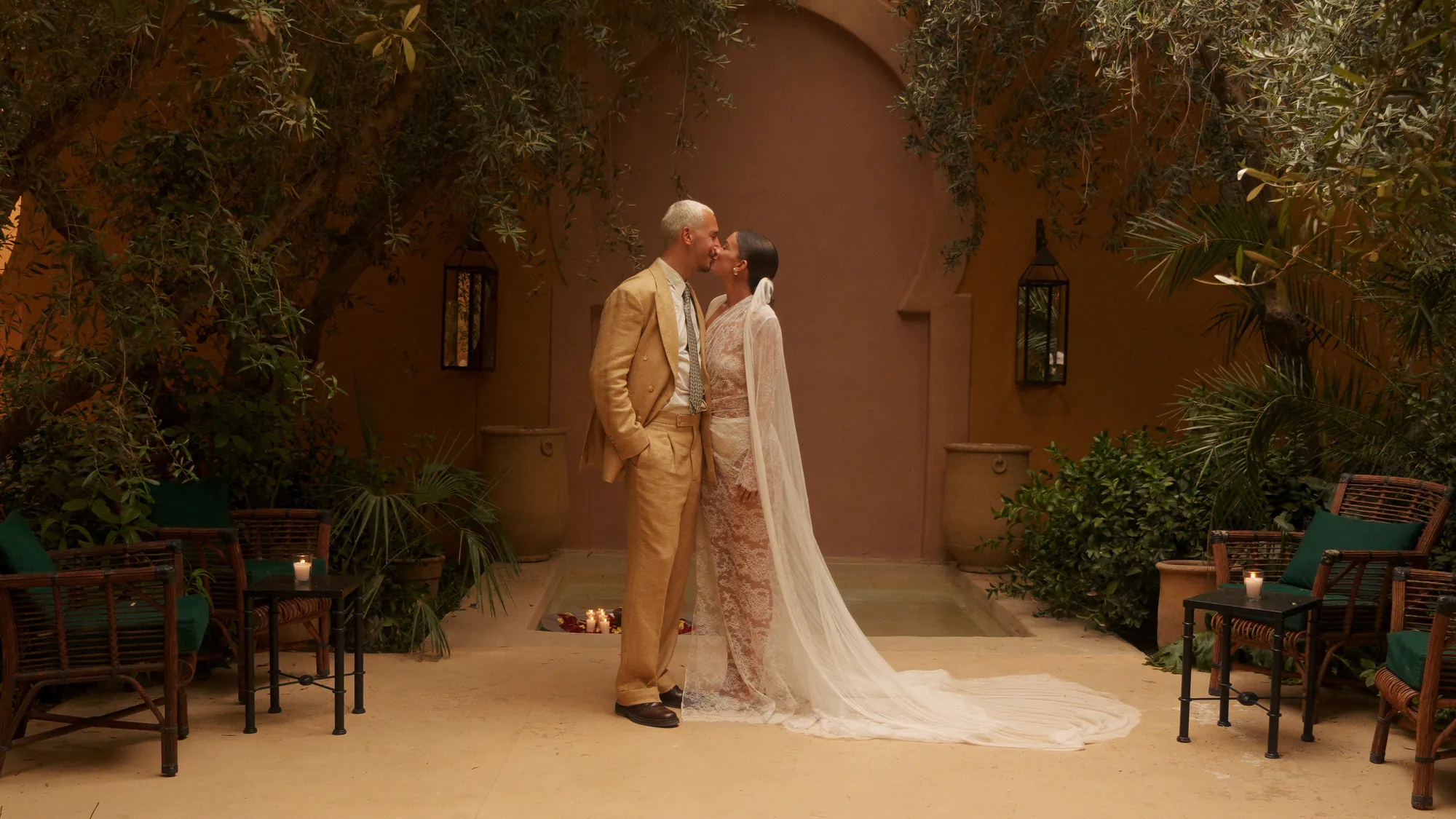
Marry at your Standesamt in Germany, then celebrate in Marrakech with a symbolic ceremony.
What a Marrakech wedding costs
There is no single number, and anyone who gives you one is selling something. What is useful is knowing which line items behave differently from a wedding in Germany.
- Cheaper here: staff and service, flowers and greenery, decoration, guest transport, musicians and traditional performers. A level of service that would be unaffordable at home is normal at a Marrakech wedding.
- Comparable or more expensive: the palace hotels, priced against London and Paris rather than against Morocco. Imported alcohol carries heavy duty. And any supplier flown in from Europe costs you their flights, their hotel and their travel days on top of their fee.
- Where couples get caught: villa weddings. A private house that looks inexpensive on paper stops being inexpensive once catering, furniture, sound, lighting, a generator and staff have all been trucked in. Riads and hotels include much of that invisibly.
Ask every supplier whether they quote in euros or dirhams, and who carries the exchange-rate risk between signing and paying. It is a boring question that has saved couples real money on more than one Marrakech wedding.
The legal side
Marrying at your Standesamt in Germany and holding a symbolic ceremony here is what almost every international couple does, and what local wedding professionals recommend.
A civil marriage in Morocco is generally only available where one partner is a Moroccan national, and the process for foreign nationals is genuinely heavy: documents, translations, legalisation, and a Moroccan marriage certificate that then has to be recognised in Germany. The paperwork adds months and adds nothing to the day itself.
A symbolic ceremony has no legal constraints at all. You choose who officiates, in which language, at what time, in any location you like — a courtyard, a garden, a desert camp at sunset. If you do want a legally binding marriage performed in Morocco, start with the German embassy in Rabat at least six months ahead and follow their guidance rather than any blog, including this one.
Your guests
This is the part most couples planning a Marrakech wedding from Germany underestimate.
Give nine to twelve months’ notice
Send a save-the-date far earlier than you would for a wedding in Germany. Guests need to book flights, request leave, and in some cases arrange childcare for several days rather than one evening.
Expect some to decline
A destination wedding is a real financial and logistical ask, and some friends will not come. Couples who accept this early enjoy their own wedding far more than those who spend a year negotiating with a cousin.
Give them one page, not five emails
A simple wedding website with the airport, two or three hotels at different price levels, the dress code, the weather in that month and what happens each day answers ninety percent of what they would otherwise ask you individually.
Block rooms early
Riads are small. A riad that sleeps twenty is full at twenty. If most of your guests want to stay in the medina, you may need two or three houses rather than one, and they should be walkable from each other.
Warn them about the heat honestly
If your wedding in Marrakech falls between June and September, tell your guests plainly what the afternoon feels like and how you have planned around it. Germans dress formally and take a dress code seriously; they will wear a wool suit in forty degrees if nobody tells them not to.

Local suppliers, or bring your own
Every couple planning a Marrakech wedding from Germany faces this question, usually about the photographer first.
Bringing a supplier from home has one real advantage: you have met them, and you share a language. It also has costs that quotes rarely show clearly. Flights, at least two nights of accommodation, travel days billed or absorbed, equipment carried as excess baggage, and the fact that they will be seeing your venue for the first time on the morning of your wedding.
A local team knows which courtyard loses its light at six, where the wind picks up in the Agafay after four, which route through the medina avoids the Saturday crowds, and who to call when a generator fails an hour before dinner. For a wedding in Marrakech, that knowledge is not a luxury — it is the difference between a plan and an improvisation.
The honest middle ground many couples choose: a local photography and film team, a local planner, and one or two suppliers from home for the things that are personal to them, such as a celebrant who will speak German at the ceremony. Our own wedding photography, film and drone services in Morocco are built around exactly that split.
Planning a Marrakech wedding from Germany: a realistic timeline
- Twelve months out. Choose your date around the season and the flight routes, visit or video-call venues, and book the venue plus your photographer and videographer. Good suppliers are booked a year ahead for spring and autumn Saturdays.
- Nine months out. Save-the-date, hotel blocks, planner if you are using one.
- Six months out. Standesamt appointment at home, catering and drinks confirmed, decoration concept agreed, celebrant booked.
- Three months out. Guest list closed, transport arranged between hotels and venue, timeline built backwards from sunset on your date.
- One month out. Final numbers, a written schedule shared with every supplier, and a plan for rain, which does occasionally fall, briefly, in spring.
- The week itself. Arrive at least two days early. Jet lag is not the issue; decisions are. Every couple who arrives the day before wishes they had come earlier.
Heiraten in Marrakesch: die Kurzfassung
Heiraten in Marrakesch ist unkomplizierter, als die meisten Paare denken. Der Flug dauert dreieinhalb bis vier Stunden ab Berlin, Köln, Frankfurt, München, Hannover, Hamburg oder Stuttgart. Für Deutschland, Österreich und die Schweiz gilt Visumfreiheit bis 90 Tage, im Winter gibt es keinen Zeitunterschied.
Fast alle internationalen Paare heiraten standesamtlich zu Hause und feiern hier eine freie, symbolische Trauung. Damit entfällt der gesamte marokkanische Papierkrieg, und Sie können Ort, Sprache und Uhrzeit frei wählen — im Riad-Innenhof, im Palasthotel oder im Wüstencamp der Agafay.
Die besten Monate sind April, Mai, Oktober und Anfang November. Planen Sie neun bis zwölf Monate Vorlauf für Ihre Gäste ein. Wenn Sie über eine Hochzeit in Marrakesch nachdenken, schreiben Sie uns Ihr Datum — wir sagen Ihnen ehrlich, ob es funktioniert.
Questions couples ask about a wedding in Marrakech
Is Marrakech safe for our guests?
Marrakech is a major tourist city and receives millions of visitors a year. The usual advice for any busy city applies: watch belongings in the souks, use official taxis or transfers arranged by your hotel, and agree fares in advance.
Do we need a visa for a Marrakech wedding from Germany?
No. German, Austrian and Swiss citizens travel to Morocco visa-free for stays up to 90 days. Guests holding other passports should check their own requirements early, as some nationalities do need a visa and the process takes weeks.
Do we need a wedding planner?
For a riad or a private villa, almost always, because someone needs to coordinate suppliers on the ground while you are in Germany. For a palace hotel with its own events team, not necessarily.
What language will the day be in?
Whatever you choose. Suppliers here work routinely in English and French. If your guests are mostly German-speaking, a bilingual celebrant is worth asking for specifically.
How much does a Marrakech wedding cost compared with Germany?
Service, flowers, decoration and transport cost considerably less than in Germany. Palace hotels and imported alcohol do not. Most couples find the total lands below an equivalent German wedding of the same standard, with the travel budget shifted from the couple to the guests.
Can we serve alcohol at our wedding?
Yes, at licensed hotels, riads and villas. It is not sold in the medina, imported bottles carry heavy duty, and service is restricted on certain religious dates. Confirm it with your venue in the first conversation, not the last.
How many days should we plan?
Three is the norm: a welcome dinner, the wedding day, and a relaxed lunch before guests leave. Many couples add a day at the start because guests arrive from different airports at different hours.
Can we visit before booking?
Yes, and you should if the budget allows. A long weekend to see two or three venues in person costs less than a mistake. Many couples combine it with their engagement shoot.
How far in advance should we book photography and film?
For spring and autumn dates, twelve months. Those Saturdays go first.
We live and work in Marrakech, which means we know which riad courtyard is dark by six o’clock and which venue’s garden faces the sunset.
If you are planning a Marrakech wedding from Germany, tell us your date and where you are thinking of celebrating, and we will tell you honestly whether it works. More planning notes are in our Morocco wedding guide.
Check your date