Can You Fly a Drone at Your Wedding in Morocco? The Real Answer for 2026
Short answer: no. You cannot fly a drone in Morocco at your wedding — not on your own, and not with a drone in your luggage. Morocco has blocked private drone imports since 2015, and the enforcement point isn’t the sky. It’s the X-ray belt at arrivals. Your drone gets taken. Sometimes you get it back on the way out. Often you don’t. Aerial footage of your wedding is still very possible, but it has to come from a licensed local operator working under a film permit, and that takes longer to arrange than most couples expect. Below: how the process actually runs, what it does to your planning timeline, and what to shoot instead if you’re already close to the date.
What’s on this page
- The short version
- Why you can’t fly a drone in Morocco
- What happens if you bring a drone in Morocco
- The only legal way to fly a drone in Morocco
- Realistic lead times and costs
- What this means for your wedding
- Venue by venue: where aerials actually work
- Aerial-style footage without a drone
- Your month-by-month planning timeline
- For photographers and crews working here
- Frequently asked questions
The short version
| Question | Answer |
|---|---|
| Can I bring my own drone? | No. Import is prohibited. |
| Will it be spotted at the airport? | Yes, almost always. Arrival bags are scanned. |
| Do I get it back when I leave? | Sometimes. Plenty of travellers don’t. |
| Is there a tourist permit to fly a drone in Morocco? | None exists. |
| Can my photographer fly one? | Not legally, and not in practice either. |
| Can I get aerials at all? | Yes, through a licensed operator on a film permit. |
| How long does that take? | Weeks. Start months out. |
| What does it cost? | Permit fees plus a local aerial unit. Budget for both. |
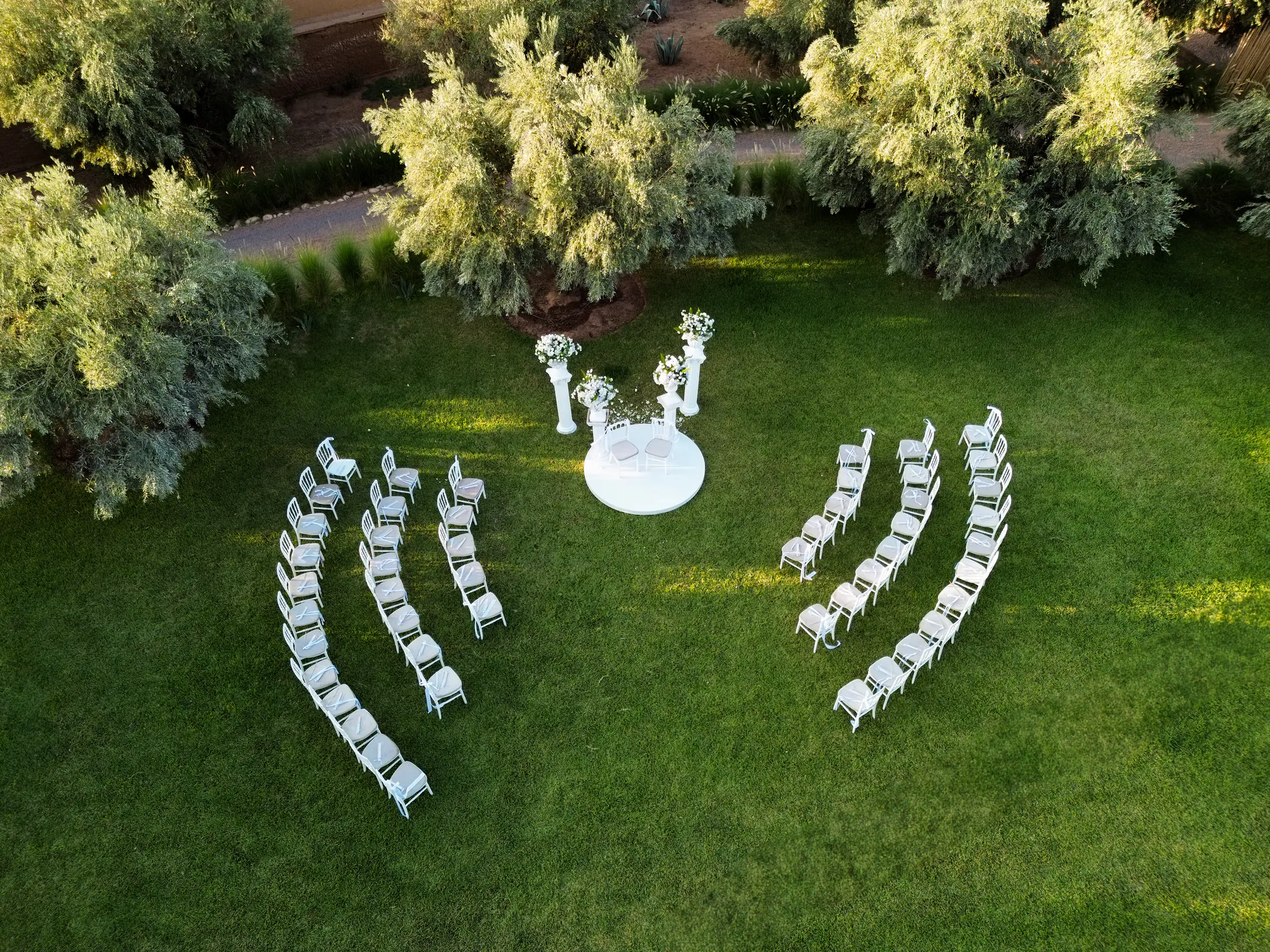
Why you can’t fly a drone in Morocco
Most couples are surprised by this, because Morocco is relaxed about almost everything else.
The restriction dates to a 2015 Interior Ministry decision banning the import and use of unmanned aircraft by anyone without authorisation. The ban itself isn’t remarkable; plenty of countries regulate drones. What’s different here is the category it falls into. Flying a drone in Morocco without clearance is treated as a security matter rather than a civil aviation one.
Once you know that, the rest stops being confusing. It’s why customs officers take it seriously, why there’s no online registration portal for visitors, why the size of your aircraft is irrelevant — a sub-250g model is treated the same as a cinema rig — and why the paperwork for legitimate operators runs as deep as it does.
The UK Foreign Office and other governments carry the same warning in their Morocco travel advice: don’t travel with one. So don’t file this under things to sort out once you land. File it alongside your venue and date decisions.
What actually happens if you bring a drone into Morocco anyway
We see a version of this every season.
Your bag goes through the scanner at Menara, Mohammed V or Agadir. Drone bodies and battery packs are unmistakable on an X-ray; nothing else in a suitcase looks quite like that. There is often signage in the arrivals hall telling you to declare it. You get pulled aside, and it isn’t a thirty-second conversation. The aircraft is confiscated, and you’ll usually be handed a receipt to reclaim it on departure.
Whether that receipt is worth anything is another question. The storage office is shut at 5am when your flight goes. There’s a fee nobody mentioned — travellers commonly report a couple of hundred dirhams. The item can’t be located. Undeclared kit is frequently reported to attract a fine in the region of 1,165 MAD (around €110) on top of the seizure.
And there’s a worse version of the story. The drone slips through unnoticed on arrival, you fly it, and it turns up in your bag on the way out. That’s a very different conversation, because by then you’ve used it — and unauthorised flying is handled as a security matter, not a customs one.
Leave it at home. Not in the hold bag, not buried in the camera case.
The only legal way to fly a drone in Morocco
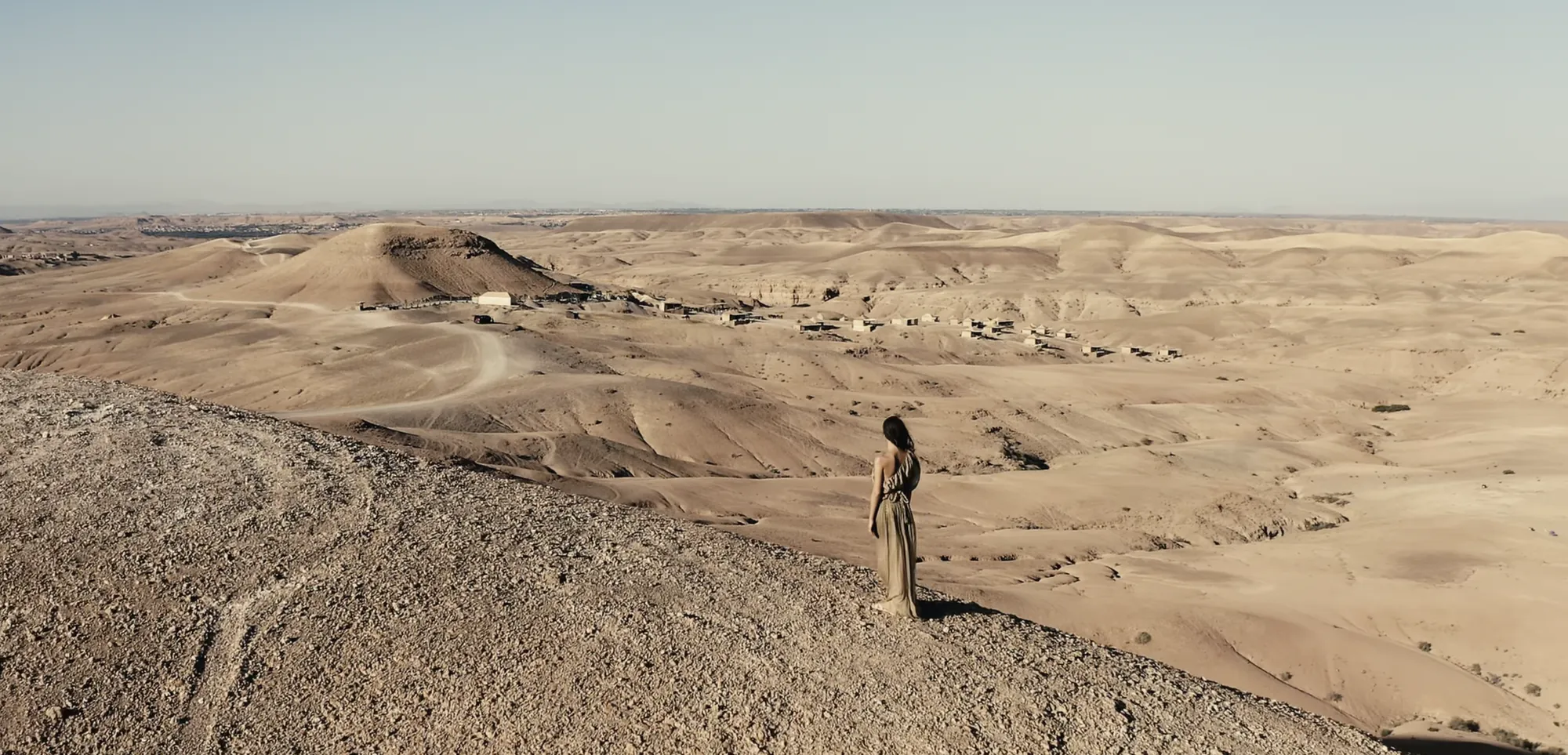
Legal aerial work with a drone in Morocco does exist. It just isn’t a form you fill in the week before.
1. The film permit comes first
Nothing moves until there’s a general filming permit from the Centre Cinématographique Marocain. The CCM states that a filming permit is issued within 15 days of a complete application — and “complete” is doing a lot of work in that sentence, because incomplete files simply aren’t processed.
Foreign companies also can’t apply directly. The application has to be sponsored by a Moroccan production company holding the right accreditation. The drone authorisation is then built on top of that permit rather than running alongside it. No film permit, no drone application. That sequencing catches people out more than anything else in this process.
2. Then the drone authorisation itself
This one is tied to a specific place and a specific moment. The application needs GPS coordinates for the flight area, the date and the time window, and details of the operator and the aircraft. It then goes through a security review, typically coordinated with regional authorities, and clearance commonly takes ten to fifteen days once it’s filed.
Which is why aerials can’t be added the week of the wedding, and why clearance for one venue is worth nothing at a second venue forty minutes down the road. If your ceremony and your dinner are in different places, that’s two applications.
3. Equipment import, where it applies
If specialised aerial kit has to come into the country, it needs its own temporary import clearance. Morocco accepts ATA Carnets, and using one is strongly recommended; without a carnet, expect deposits and delays at the border. Where a full temporary import licence is required instead, that process usually lands somewhere near forty days, and it runs on top of everything above rather than inside it.
In practice, most wedding clients never touch this stage. A local aerial unit already has authorised aircraft in the country, which is exactly why using one is faster as well as cheaper.
Realistic lead times and costs
| Stage | Allow for |
|---|---|
| CCM film permit | Around 15 days on a complete file; longer in peak season |
| Drone authorisation (only after the above) | Ten to fifteen days, region dependent |
| Temporary equipment import, if needed | Around 40 days without a carnet |
| Second venue or second date | A separate application each time |
| Safe buffer | 3 to 4 months before the date |
On cost, hiring a drone in Morocco has two separate lines and couples routinely see only one of them. There’s the administrative side — permit fees, the local sponsoring company, and any location fees where a venue or site charges for filming. Then there’s the aerial unit itself: pilot, spotter, aircraft, and the half-day of shooting time that sits around a fifteen-minute flight window.
Ask for both to be broken out in writing before you commit. A quote that shows “drone included” as a single line is the one that goes wrong later.
Rules, fees and processing times shift, and enforcement varies by region and by what’s happening nearby that week. Confirm anything here with your operator and the relevant authorities when you book. Last checked: August 2026.
What this means for your wedding
If your photographer is flying in from abroad
They can’t deliver aerials. It’s worth saying plainly, because this is one of the most common gaps between what a couple was quoted and what actually arrives.
A photographer based in Paris, London or New York can’t legally bring a drone in Morocco through customs, can’t get a tourist permit, and won’t hold a CCM film permit for your date. If aerials appear in your quote, ask how. There are only two honest answers: they’re subcontracting a licensed local operator, or you aren’t getting them.
Worth asking before you sign:
- Who is actually flying, and are they licensed here?
- Is a CCM permit being filed for our date and our venue?
- Which locations does it cover? All of them, or just the ceremony?
- Whose aircraft is it, and is it already in the country?
- What happens to the fee if the authorisation doesn’t come through in time?
That last one matters. Weather and security reviews both fail sometimes. You want the refund position agreed in the contract, not discovered on the day.
If you’re hiring locally
Simpler. A Morocco-based operator can start the permit process for you, file against your actual venue coordinates, and build the flight window into the day’s timeline instead of squeezing it in.
The advantage isn’t only legal. That flight window has to sit correctly against your ceremony time and the light, and at some venues against noise and neighbours too. It’s as much a scheduling problem as a paperwork one. If you’re still shaping the day around the light, our guide to wedding venues in Marrakech covers how each location handles late afternoon.
Venue by venue: where a drone in Morocco can actually fly
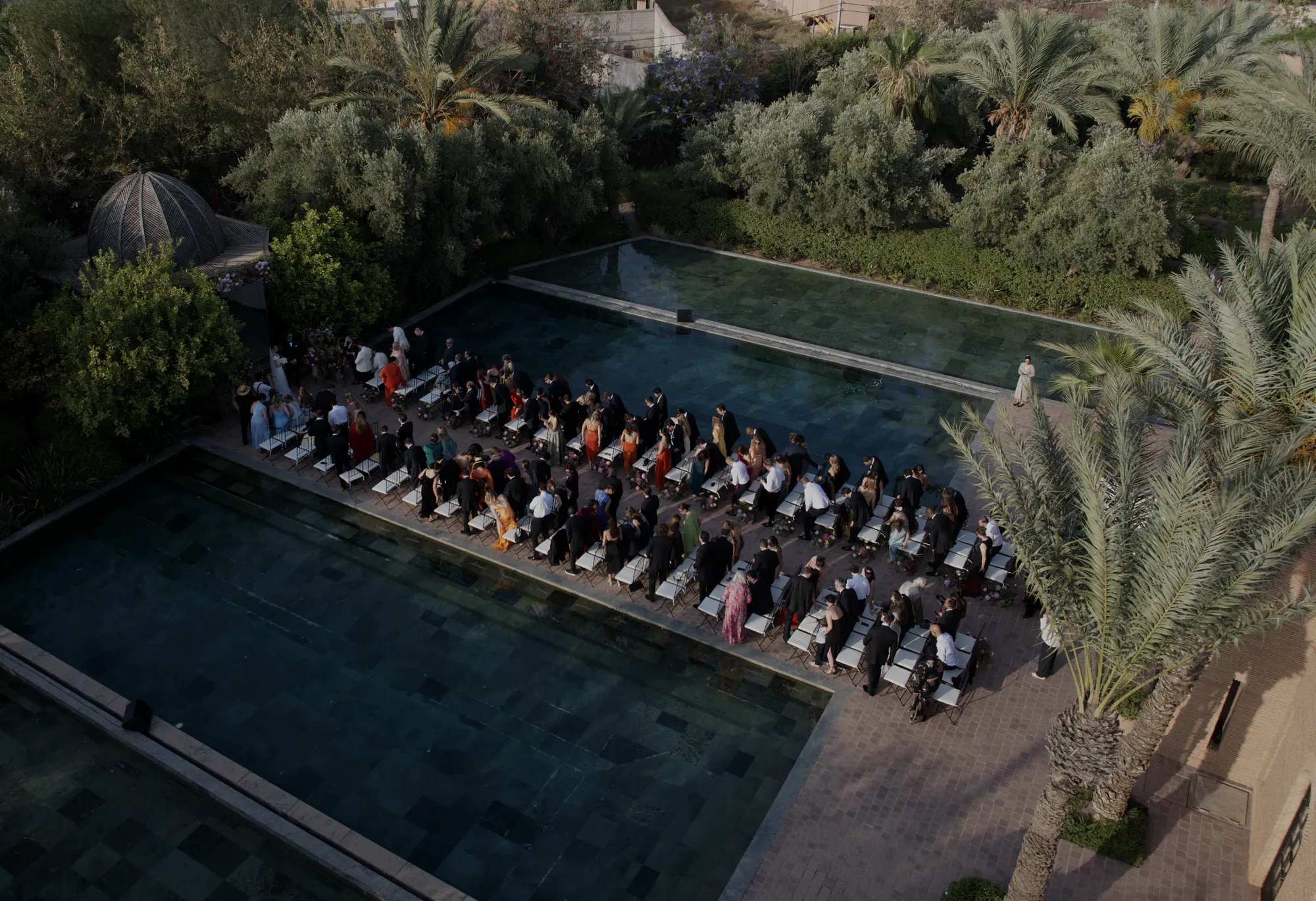
Permit or no permit, not every Marrakech location is realistic for a drone in Morocco to work from.
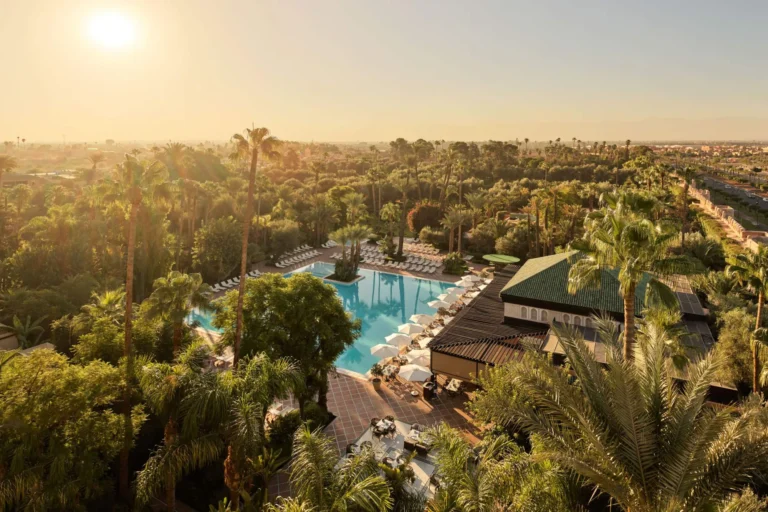
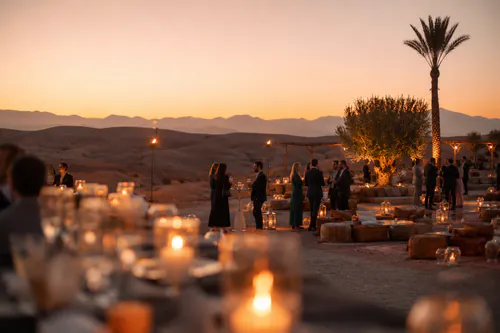
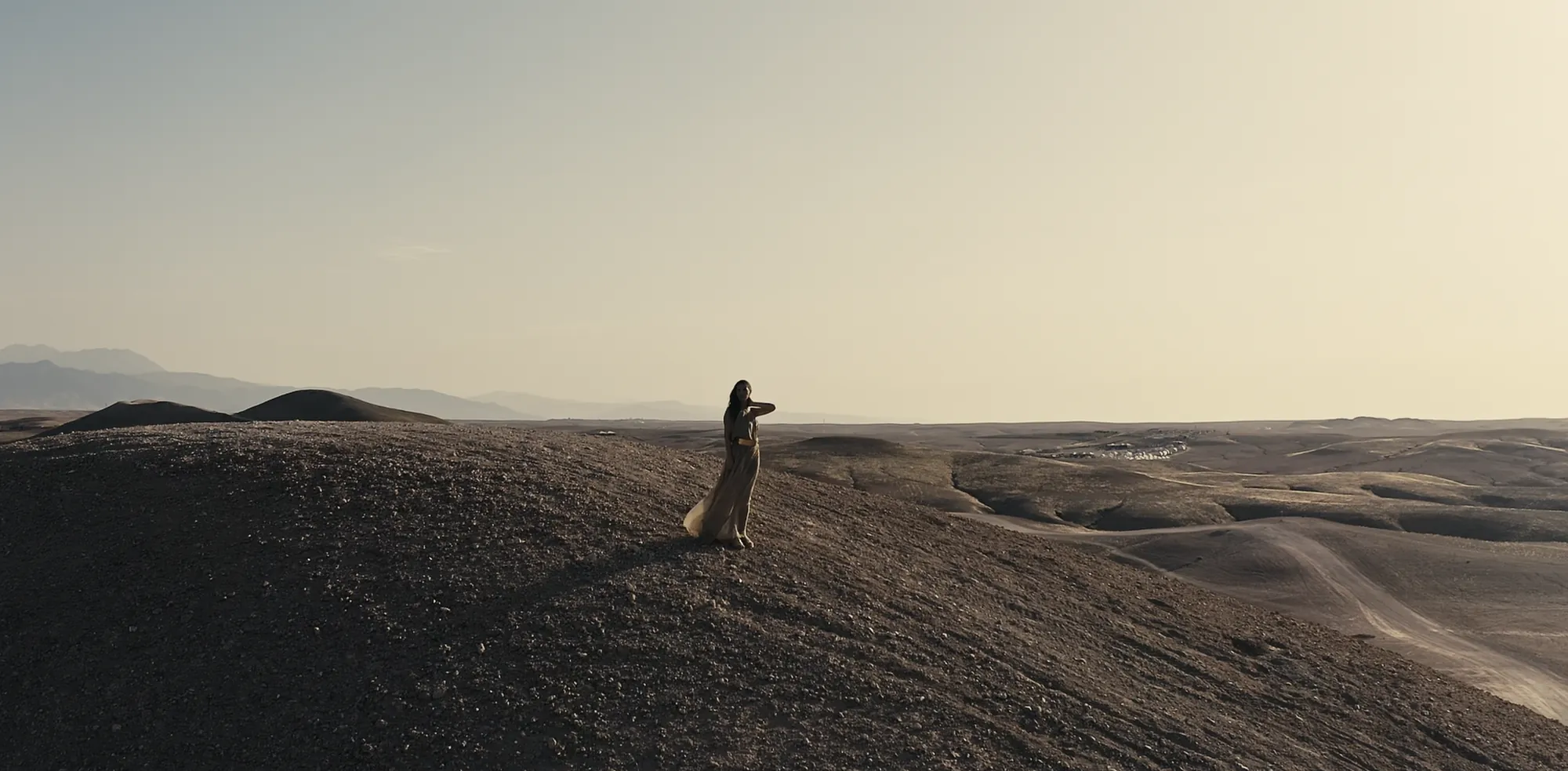
Agafay is the best of them. Open ground, almost nobody around, and the results speak for themselves. The genuine constraint isn’t paperwork, it’s wind. Late afternoon in Agafay can be strong enough to ground a flight no matter what your authorisation says, and that’s usually the exact hour you wanted to shoot.
Palmeraie villas generally work, though neighbouring properties and privacy are a real consideration rather than a formality. Expect the flight path to be shaped around what’s next door.
The medina and riads are the hardest environment in the city. Dense residential airspace, heritage sites, low rooftops, tight sightlines. Assume no aerials and plan rooftop coverage instead.
The Atlas and Ourika can work in open valley positions, but terrain and altitude change what’s achievable, and a valley floor surrounded by high ground limits how much of a rise you actually get.
Anywhere near an airport, a royal residence or a military site is a firm no. That rules out more of the Marrakech area than people expect, and it’s worth checking before you fall in love with a venue.
Aerial-style footage without a drone
If the timeline is too tight, or the location rules a drone in Morocco out entirely, you don’t lose the shots. These are the alternatives that genuinely hold up.
- Rooftops and terraces. Marrakech is a low city, so three storeys already gives you scale, and on a clear day the Atlas sits right on the horizon behind everything.
- Venue geography. Several Atlas and Ourika properties are built into slopes, which means the establishing wide is already sitting there waiting for you.
- Long lenses from a distance. A compressed telephoto across an olive grove or the Agafay stone reads as cinematic scale without a metre of altitude.
- Cranes and jibs. No authorisation issues, and hard to beat for a reveal over a dinner table or down an aisle.
- Golden-hour landscape plates, shot separately without guests and cut in as establishing footage.
- Stabilised walk-ins on a gimbal, starting high on a terrace and descending into the party — movement reads as much as altitude does.
For what it’s worth, a film that’s strong at ground level will beat one leaning on aerials to cover the gaps. Aerials are punctuation. You can see how we use them in our recent wedding films.
Your month-by-month planning timeline
- 6 months out. Confirm venue and ceremony time. Ask your planner whether the site sits near any restricted zone before contracts are signed.
- 4 months out. Decide whether you want aerials at all, and appoint the local unit. This is the real deadline.
- 3 months out. CCM file goes in, with locations, dates and coordinates attached.
- 6 to 8 weeks out. Drone authorisation filed on the back of the approved permit.
- 2 weeks out. Flight window locked into the run sheet against sunset, ceremony and speeches.
- On the day. Wind call. Everyone should already know what the ground-level plan B looks like.
For photographers and crews working here
If you’re travelling in for a wedding or a commercial shoot, the answer is the same one your clients get. You can’t bring your own aircraft, and there is no visitor route to operating a drone in Morocco legally.
What the industry actually does is subcontract a local aerial unit that already operates under film permits and can file for your dates and coordinates. You keep the client and the creative direction. The local unit handles authorisation, equipment and the flight, and briefing them properly a few weeks out gets you far closer to your board than a rushed handover on the morning.
We work as a licensed aerial unit in Marrakech and regularly shoot second unit for international photographers and production companies. Send us your dates and locations and we’ll tell you straight whether the timeline works.
Frequently asked questions
Can tourists fly a drone in Morocco?
No. There’s no recreational pathway at all. Private use is prohibited and import is blocked at customs, regardless of how small the aircraft is.
What happens if customs finds a drone in my luggage?
It gets confiscated. You may be given a receipt to reclaim it on departure, but a lot of travellers report never seeing it again, or being charged a storage fee they weren’t told about. Undeclared kit is commonly reported to draw a fine of around 1,165 MAD as well.
Should I declare it instead of hiding it?
Yes, if you’ve somehow arrived with one. Declaring usually means the aircraft is held in bond and logged against your passport until you leave. It’s the better outcome, but it grants no permission to fly.
Can I get a drone permit for my wedding?
Not as a private individual. Authorisation is granted case by case for professional and production work, and it requires a CCM film permit first, then GPS coordinates, a fixed date and time, and a security review.
How far ahead do I need to arrange this?
Three to four months. The film permit runs around fifteen days on a complete file, the drone authorisation another ten to fifteen after that, and if equipment has to be imported without a carnet that alone can run near forty days.
Can my photographer from France or the UK bring one?
No. The import restriction applies to everyone, whatever their profession. Aerials have to come from a locally licensed operator.
Is it easier to fly a drone in Morocco out in the Sahara or Agafay?
The law is identical everywhere. Open desert is more likely to be approved and far easier to fly safely, but the authorisation requirement doesn’t change. Wind is the practical limit out there, not paperwork.
What about a riad in the medina?
Realistically, no. Between the residential density, the heritage buildings and the privacy issues, it’s the hardest environment in Marrakech for aerial work. Plan rooftop coverage instead.
Does one permit cover both my venues?
No. Authorisation is tied to specific coordinates and a specific time window, so a ceremony in the Palmeraie and a dinner in Agafay are two separate applications.
Any way to get the look without a drone?
Yes. Rooftop elevation, elevated venue positions, telephoto compression, cranes, and separately shot landscape plates. None of it is restricted, and none of it depends on a security review landing in time.
The bottom line
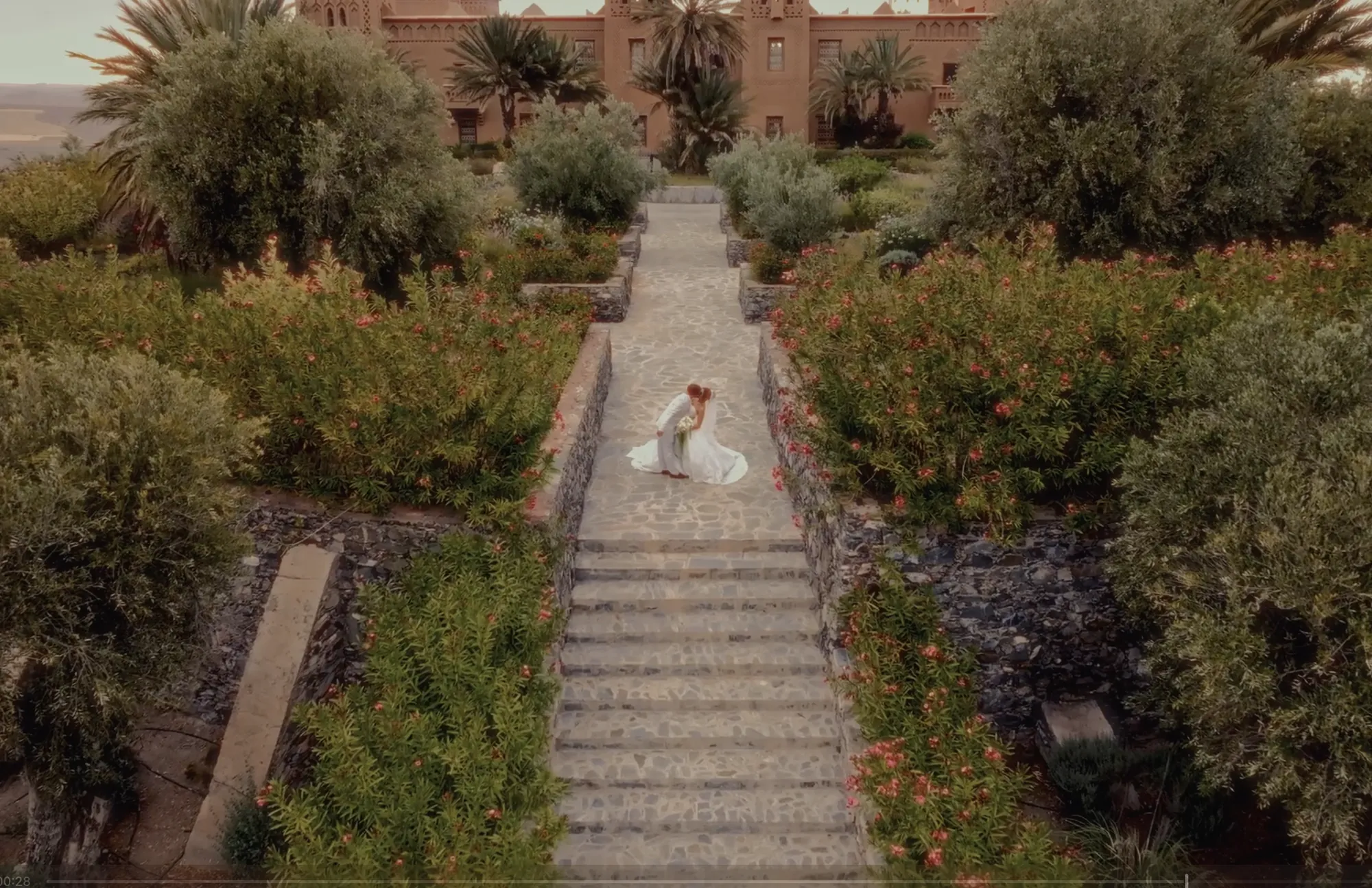
The rules on flying a drone in Morocco aren’t a formality you can work around. They’re enforced at the border and handled as a security question. But aerial footage of your wedding isn’t off the table at all. It has to be planned early, filed properly, and flown by someone licensed to be up there.
Nobody regrets wanting aerials. What they regret is finding out in month eleven that nobody arranged them.
We film weddings across Marrakech, Agafay, the Atlas and the Sahara, and aerial authorisation is part of what we handle. Tell us your date and venue and we’ll tell you what’s realistic.